We awoke on the morning of April 14, 1999, to a rain storm in Galilee. It was the only rain I saw in all of my time in Israel.
The storm has stopped by the time we reach our first destination of the day, the Dan Nature Preserve. It was this area in which the tribe of Dan was given to live, and now a beautiful forest has been set aside. It is here that the River Jordan runs wild. The waters of this and other brooks and streams come out of the ruins of the tribe of Dan, combine with the runoff from Mount Hermon, and flow into the Sea of Galilee.
The Hebrew word for "going down" is yored, and there are some who believe that the origin of the name Jordan is the term or expression yored-Dan. Though Joshua led the children of Israel across the River Jordan before the tribe of Dan settled in this area, perhaps the account of the crossing, written later, simply used the then-known word "Jordan." As we walk along in this forest I am struck that this is the last thing I would have expected to find in Israel.
Back on the bus we are now traveling north through the Hula Valley. When Jewish settlers arrived here in the 1940s and 50s they found nothing but stinking swamps. Undeterred, the settlers set to draining the swamps and making the land fruitful. They succeeded and several settlements dot the fertile countryside.
Metulla is the northernmost city in Israel. It is like an alpine ski village and there are two ski lifts on Mount Hermon, which rises to almost 10,000 feet. Nearby is Kibbutz Kfar Giladi, which was founded in 1916. It is a typical agricultural collective settlement, but it also has a popular hotel with tourist facilities. In Hebrew the word kfar means "small town" or "village," and a gentlemen named Gilad was one of the town's founders. Next to the Kibbutz is the city of Kiryat Shemona. Kiryat means "city" in Hebrew and Shemona means "eight." The City of Eight was named for eight men who defended this area during the 1948 War of Independence. Their Arab attackers were unaware that the eight men were mortally wounded. The eight fought so fiercely that the attackers fell back and abandoned the attack.
When Israel proclaimed statehood in 1948 many Arabs from northern Israel settled in southern Lebanon. Recently many thousands of these Moslems and Christians have come back across Israel's "Good Fence" for medical aid as well as to shop for basic necessities. Up to the year 2000 there were hundreds of Lebanese that regularly worked in Israel.
At the foot of Mount Hermon, by a huge rock escarpment, new excavations are revealing the once prominent Roman City of Caeserea Philippi. It was here that Jesus Christ asked of Peter and the apostles "Whom do men say that I the Son of man am?" (see Matthew 16:13-19)
We are now entering the Golan Heights. Here and on Mount Hermon there are several villages of Druze, a people claiming to be descendants of Jethro, the father-in-law of Moses. The Druze are an industrious, secretive, and colorful people. They are also an integral part of modern Israel, serving in the government and the military. Half of the Druze people live across the border in Syria. Israel has made repeated efforts to open the border for family reunification. This has slowly happened, but underneath the radar. Publicly the Druze proclaim Syria as their mentors, while hundreds of Druze have crossed back and forth across the border. There are annual protests that have prompted our guide to coin the term "Druze Ruse." All of this will probably continue as long as the media does not publicize the crossings.
During the first two decades of the modern state of Israel it became clear that the Syrians were using the Golan Heights as nothing but a gun platform for firing down on Israeli settlements in the Hula Valley and around the Sea of Galilee. The Six-Day War of 1967 was a preemptive counteroffensive launched by Israel, and during this conflict the Golan Heights were taken from Syria.
Since the war heights have become a peaceful place -- except for a few days in 1973. Israelis have cleared this rocky land and discovered great farming soil and new water sources. A unique combination of rich volcanic soil and modern farming techniques have produced outstanding agricultural yields, including award-winning grape and wine production.
As we drive across the Golan Heights our guide tells us of the surprise offensive of Syria in the Yom Kipur War of October 1973. As a military history buff I am enthralled by the story. Out of the windows we see beautiful, fertile fields, a few military installations, and tanks or tank turrets that have been turned into memorials.
We now descend back to the shores of Galilee and the ruins of Capernum.
In recent years the ruins of Capernaum have been uncovered by excavations. This toll city for Rome may have had ten thousand Jewish and Roman inhabitants. Carpernaum was also the place where Jesus Christ performed most of his miracles. Among them:
Peter finding a coin in the mouth of a fish big enough to pay the toll (see Matthew 17:25-27).
A palsied man being lowered on his bed through a roof and healed by Jesus (Mark 2:3-12).
The healing of a man with a withered hand (Matthew 12:10,12 & 13).
The healing of Peter's mother-in-law (Matthew 8:14-15).
After failing to catch fish all of one night Peter was instructed by Jesus to lower his nets, he did so and caught an unbelievable amount of fish (Luke 5:3-6, 9-11).
The healing of the Roman Centurion's servant from a distance (Luke 7:1-10).
A woman being healed by the simple act of touching Jesus' garment (Mark 5:21-34).
At the time Jesus was on his way to heal the daughter of the leader of the synagogue. Because he was delayed he arrived to find the child dead. Jesus sent all the mourners away and then entered the room where the child lay. He then took her hand and said "Talitha cumi." The endearing term Talitha may have been his way of saying "my little lamb," or "curly locks" and cumi means "get up" in Hebrew. The child arose and walked (Mark 5:40-42).
Returning to the story of the Centurian, this Roman had a great love for the Jewish people, so much so that he built them a synagogue in Capernaum. It is in the ruins of this meeting house that we sit and read about these many miracles.
Our guide also introduces us to a garment of wool called a Talith. It is a shawl-like garment worn by modern Jews, and the name seems to come from the Hebrew word meaning "lamb," taleh. The hem or the strings of the talith are customarily touched during Jewish religious services. The four sets of strings are knotted for a sum total of 613 strings and knots. There were 613 laws and covenants -- including the Ten Commandments -- given to Moses. Modern Jews touch the strings and knots to remind and commit themselves to keeping the laws.
Perhaps the woman who touched Jesus' garment and was healed, touched, or was trying to touch, his talith.
It is a short drive from Capernaum to the traditional site of the Mount of the Beattitudes, or the place where Jesus taught the Sermon on the Mount. This is on the northern shore of the Sea of Galilee and it is a remarkably peaceful place. Even ancient travelers have written of the peaceful feeling of this Mount. Today a church designed by Italian architect Antonio Barlucci, sits on the hill overlooking the sea.
After a brief walk-through of the church we find a spot on the hill and read through the Sermon on the Mount. For me this is one of the main highlights of the trip. "What a place of sweet spirit," as many a traveler has written. Add to it the beautiful scenery, and it is an experience to be unmatched by any other. There are two places in Israel I most yearn to visit again, and this hill is one of them.
Down to Tiberias we go, enjoying more of the beauty of the land around the Sea of Galilee. We stop for lunch and are each served St. Peter's fish. In reference to the story where Peter found a coin in the mouth of a fish, one person at each table finds a coin in the mouth of their fish -- at my table it is my wife who finds the coin.
After lunch we enjoy a brief boat ride on the Sea of Galilee. The sea is 700 feet below sea with heights surrounding, including Mount Hermon which rises almost 10,000 feet. Because of this it is quite common for sudden storms to arise on the lake. We are lucky today as there are no storms, just a beautiful sunny day. Our short boat ride takes us to another part of Tiberias. At this place a Christian group has a store and theater where they present a slide show called "The Galilee Experience." The slide show covers 4,000 years of history.
After this we end the day of touring a little early, so that many in the group can return to the spa hotel for many of the massage therapies provided. My wife really enjoyed the aromatherapy she received.
The next day will see us on the Mediterranean coast before returning to Jerusalem.
Jericho sits at the foot of the Judean hills, just north of the Dead Sea. It is a quiet town and the home of fruit and vegetable growers. We saw pineapple plantations that were magnificent and beautiful. A chicane took us through a security checkpoint and into the West Bank. We did not stop in Jericho, but our guide told us a few stories as we passed through.
First the story of Joshua and the Children of Israel marching quietly around the walls of Jericho once a day for six days. Then on the seventh day they made another six silent walks followed by a seventh very noisy march with trumpets and shouts, and the walls came tumbling down.
Off to the left we see an ongoing excavation of those very walls. On the trade route, Jericho was conquered at least 28 different times.
Now our guide is telling us about Achan. This Israelite violated the commands of God by keeping some of the riches of Jericho for himself, instead of turning it over to Joshua and the Lord's treasury. Because of this the Israelites were defeated in their next battle. A subsequent investigation discovered Achan's crime and he and his entire family were stoned to death and then burned by fire with all their possessions.
Now look to your right at the palm tree at the end of the street. That tree marks the traditional site of a teaching moment of Jesus Christ. When he was teaching in Jericho, a tax collector named Zacchaeus climbed a tree to better see and hear. Jesus then invited himself to dinner at Zacchaeus' house and the people murmured that Jesus was socializing with such a person as a tax collector.
The Romans had set up a quota system for taxation, and it was necessary for collectors to collect above the normal rate when the economy was good so that the quota could be met when the economy went bad. The people believed that Zaccheaus had abused the system to his own benefit. In any case, Zacchaeus was so impressed by Jesus' teachings that he offered half of his wealth to the poor and fourfold repayment to the people he had wronged.
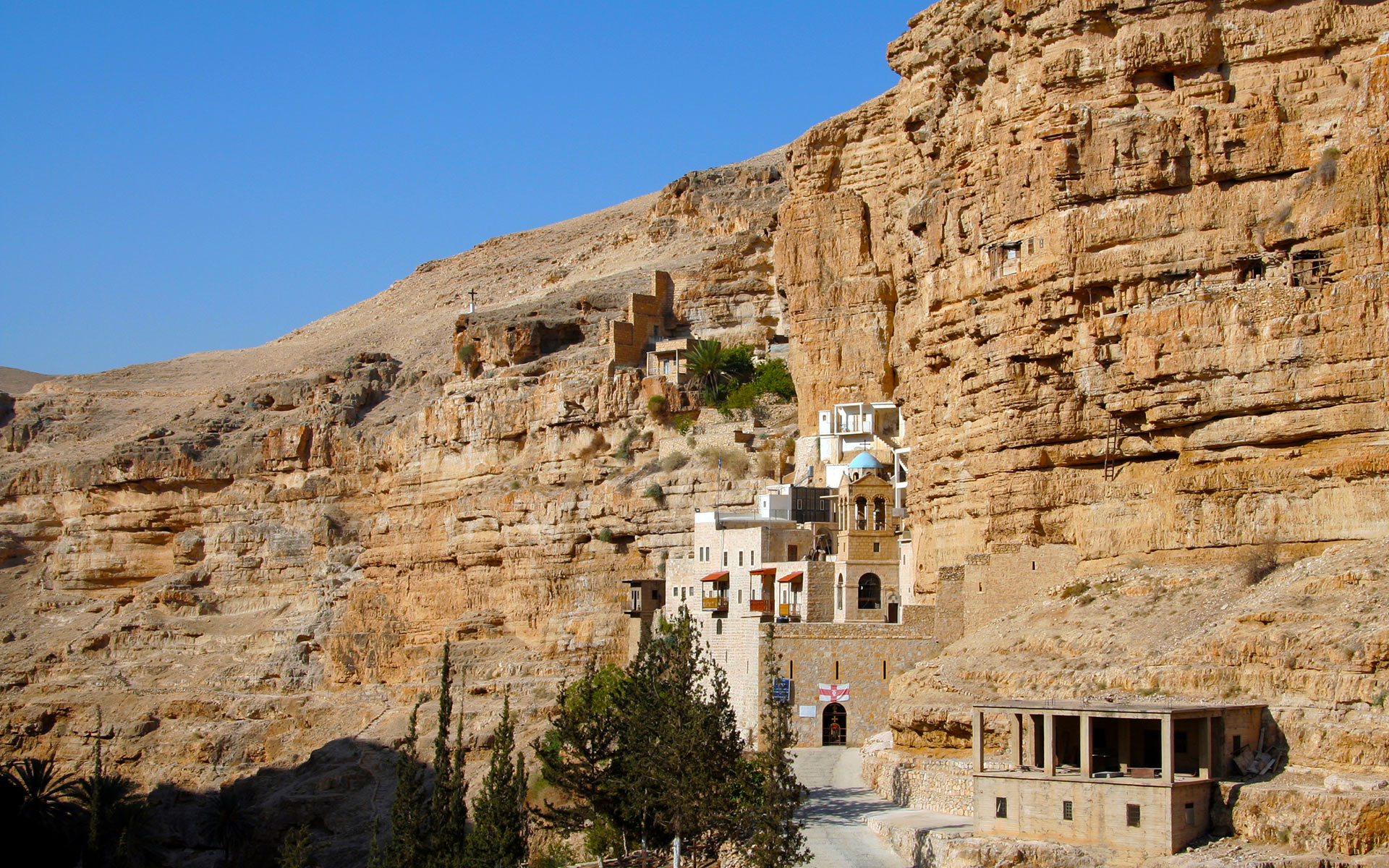
Our glance at the tree is brief as the tour bus turns left and leaves Jericho behind. Ahead we see a high mountain that is the traditional spot where Jesus may have been tempted by the Devil. A monastery has been built into the side of the Mount of Temptation.
We are now in the valley of the Jordan River. There is a song that tells of where the River Jordan runs wild, but it is not here in this valley. Because of the Dead Sea Israel built a dam at the mouth of the Jordan on the Sea of Galilee to control the amount of water released. So it is rare that we can actually catch a glimpse of the River Jordan as it winds its way south, it meanders for some two hundred miles to arrive just sixty-five miles south of Galilee.
Along the road we can see stretches of flat sand and dirt. At least once a day the Israeli Defense Forces drag these stretches. When they come back to drag them again they will be checking for footprints or other tracks that might indicate that infiltrators have crossed the Jordan River into Israel.
Now our guide is telling us about a bridge built across the Jordan River after a peace agreement was signed with the nation of Jordan. The bridge was opened with a ceremony which had King Hussein walking to the center of the bridge to meet a delegation from Israel. The "delegation" turned out to be a group of Israeli children running to greet the king. The king then knelt to embrace each child as tears rolled down his cheeks.
Our guide tells us that when he watched the international news that evening that he had the impression that the reporters and anchors just did not get the significance of the event. But, as I listen to the story, there are tears in my eyes. I get it. Children know how to greet a king. "Suffer the little children to come unto me."
As we travel north through the Jordan River Valley we can see a stark contrast between Jewish and Arab settlements. But nothing is more stark in contrast than the site of Bedouin tents and automobiles. There are still many Arabs and Bedouins living the nomadic life. This lifestyle differs little from that of their ancestors; tents are still made of goat hair strands woven together, and the tents are still aligned north-south with their openings to the east. There are two startling differences as one sees the cars and the TV antennas.
For some Bedouins their lifestyle is changing from the north-south tent to the north-south stone and cement house. They are becoming organized, too, electing their own town officials and putting their representatives in national government. They are very happy to have their own people administering their school system as well as advanced agricultural facilities that the State of Israel helped them establish.
Our guide is now telling us about the decision of the Israeli government to replace the rancid wells of the Bedouins and Arabs with a modern water system. There were protests picked up by the international media. But somehow only the destruction of the wells was reported. This created a greater uproar among the Palestinians and neighboring Arab countries. Nonetheless, the State of Israel continued with the construction of the modern water system and the controversy eventually went away.

Now we cross a bridge over the River Jordan and catch a glimpse of brown muddy water. We have entered Galilee. Here on the south shore of the Sea we stop at a place of baptism. At the urging of the Israeli Ministry of Tourism, local residents constructed a pleasant spot on the river that many Christians come to for baptism. It is a beautiful location among trees with a large green pool, of sorts, in the River Jordan. As we take in the scene we see one child baptized. There are others awaiting their turn, and still others now drying off and celebrating a joyous occasion.
But, as beautiful as the setting is, it is likely that John the Baptist did his immersions at a spot much closer to Jericho. It was common in those days for Jews to be immersed, often insisting that the water be "living water," that is, out of bedrock. It should also be flowing and always below ground level.
Now we drive along the west coast of the beautiful Sea of Galilee. Soon we arrive at the spa hotel, high above the northwest shore, where we will stay the next two nights. I will remember this stay in Galilee as the best part of the trip. Oh what a beautiful and peaceful place!
We awoke early on the morning of April 13 for a quick breakfast and the start of the tour. Our first day would take us south to the Dead Sea and then north to the Sea of Galilee.
Our tour bus takes us down the Wadi Joz and the Kidron Valley. It is more of a ravine, actually, between the Mount of Olives and the Old City on Mount Moriah. We pass underneath the Gate Beautiful on one side, and the Church of All Nations on the other. Then to our left is a large cemetery with ancient above ground tombs, white sepulchers . Soon we are passing out of the city and into the desert,
Jerusalem is like a hand with the tips of the fingers pointing to Mediterranean Sea. The roads in and out of Jerusalem are like your fingers and wrist. The "thumb" points north and leads to Samaria. The "pointer finger" points northwest and leads to Modiin. The "middle finger" points westward and leads to Bet Shemesh. The "ring finger" points southwestern and leads to the Valley of Elah. The "pinky finger" points southward and leads to Bethlehem. Following the "wrist to the elbow' route will take you east to Jericho.
As we travel down to the Dead Sea we are presented with a stark contrast. Believe it or not, but the hills around Jerusalem receive the same annual rainfall as the City of London (about 23 to 26 inches per year). But just a dozen miles away the Jordan Desert receives less than one inch of precipitation annually. As we cross below sea level the windshield wipers of the tour bus starts to function. This happens every time we cross sea level.
The landscape around the Dead Sea is much like a moonscape. But there are hardy souls, both Jewish and Arab, who are making spots here and there in the desert to blossom like a rose. Literally. Israel is the leading exporter of roses to Europe!
Our first stop is at Qumran. In the late 1940s two Bedouin boys made a significant discovery here. As the story goes, they were tossing stones into caves and then went to explore one. One of their stones had hit a clay jar that had lain unfound for almost two thousand years. There were leather scrolls wrapped in musty cloth, but they were meaningless to the boys. Eventually they sold the scrolls for a "few dollars" to a shoemaker in Bethlehem. The shoemaker then sold the Dead Sea Scrolls to a Jewish scholar, Dr. Eliezer Sukenik, for a substantial profit.
Once the Bedouins learned how valuable the scrolls were they began to comb the caves of Qumran for more to sell. Eventually the French and Jordanians moved in to secure the area and protect the antiquities.
As we stand at the overlook learning about the scrolls we each throw stones toward the caves to see if we can throw them far enough. Most of our rocks fall well short of the caves.
The Dead Sea is the lowest place on earth at thirteen hundred feet below sea level. The mineral content of this great salt lake is about 27 percent, which is the maximum mineral saturation water can have at this elevation at temperature.
Rising 1500 feet above the Dead Sea is the mesa upon which Herod the Great built two large palaces. Totally isolated and without life support, this ancient Palm Springs was also a fortress to protect Herod from his enemies, real or imagined; magnificent buildings, pools, baths, and fountains defied nature. There were enormous food-storage chambers and many plastered cisterns carefully surrounded by double walls and lookout towers.
Today Masada, mostly in ruins, is accessed by a tram -- most of the way up, the last bit is a steep stone stairway. At one point, my mother turned to my wife and said "I hate these stairs."
We spent an hour on top of this mesa. At one point we all stopped and bowed our heads for a full minute while a siren blared. It was Holocaust Day in Israel.
After Herod's death the Romans used the palaces of Masada for their own enjoyment. Suddenly a band of Jewish Zealots climbed up undetected and routed the Roman soldiers. In response Romans came and laid siege to the fortress. They began to build a ramp to the top of the mesa only to be stopped by Jews who threw boulders down on top of them. To counter this the Romans brought Jewish slaves from Jerusalem to build the ramp.
When it was obvious to the Jewish Zealots that the Romans would enter the fortress they met the night before and made chilling pact. The next day, when the Romans entered, they found that all 960 men, women and children had taken their own lives.
As a World War II history buff, I had visions of American G.I.s stumbling on Nazi concentration camps. Perhaps the horror for both the G.I. and the Roman soldier were similar.
But all of this was just a story told by the Jewish-turned-Roman historian Josephus. Then excavations made between 1963 and 1967 confirmed many of the strange and almost unbelievable facts that Josephus had written about some 1900 years earlier.
Modern Jews feel a collective identity to those Jewish Zealots whose credo was, "Death rather than slavery." Israeli children and soldiers each visit Masada at least once in their military or educational years. Some boys have their Bar Mitzvahs atop the mesa. In the past some Israeli military units took their oaths in the ruins of the ancient fortress crying out, "Masada shall never fall again!"
But, even as the honor and memory of the Zealots' resolve is maintained, the youth of Israel has begun to question the necessity of their actions. The fortress had no strategic value, so taking it from the Romans (and their taking it back) was senseless.
After coming down from Masada, and after lunch at the sandwich shop at the foot of the mesa, we went to a little resort on the Dead Sea. Some of our group changed into their swim suits for a quick float in the salt lake. Still others were covering themselves with Dead Sea mud, known supposedly, for its healing properties -- mud is actually exported to people around the world.
The rest of us just got our feet wet.
Close your eyes for a moment and try to visualize the land of Israel. What do you see? Do you see a land that is mostly flat and arid? Do you see trees? There is a Christmas hymn that goes "Far, far away on Judeas Plains, shepherds of old heard the joyous strains. . . ."
We arrived in Tel Aviv on the afternoon of April 12, 1999. After going through customs we met other members of our tour group and got on a tour bus for the trip up to Jerusalem.
Up is right. Ben Gurion Airport and Tel Aviv are on the coastal plain and Jerusalem is about 2,000 feet above sea level. As we drive across this coastal plain I see farmland and trees everywhere. I saw more trees than I had anticipated. Oh, what a beautiful country!
The previous night was spent over the Atlantic ocean, and try as I might, I could not sleep; now, as I desire to see as much of the countryside as I can the lack of sleep is catching up to me. I fight it all I can, I nod off but spring awake trying to see as much as I can. I keep nodding off and forcing myself awake as we begin the climb from the coastal plain. As we enter Judea the landscape is changing. It is no longer flat, and there are fewer trees, as we find ourselves among the seven hills that make up the modern city of Jerusalem.
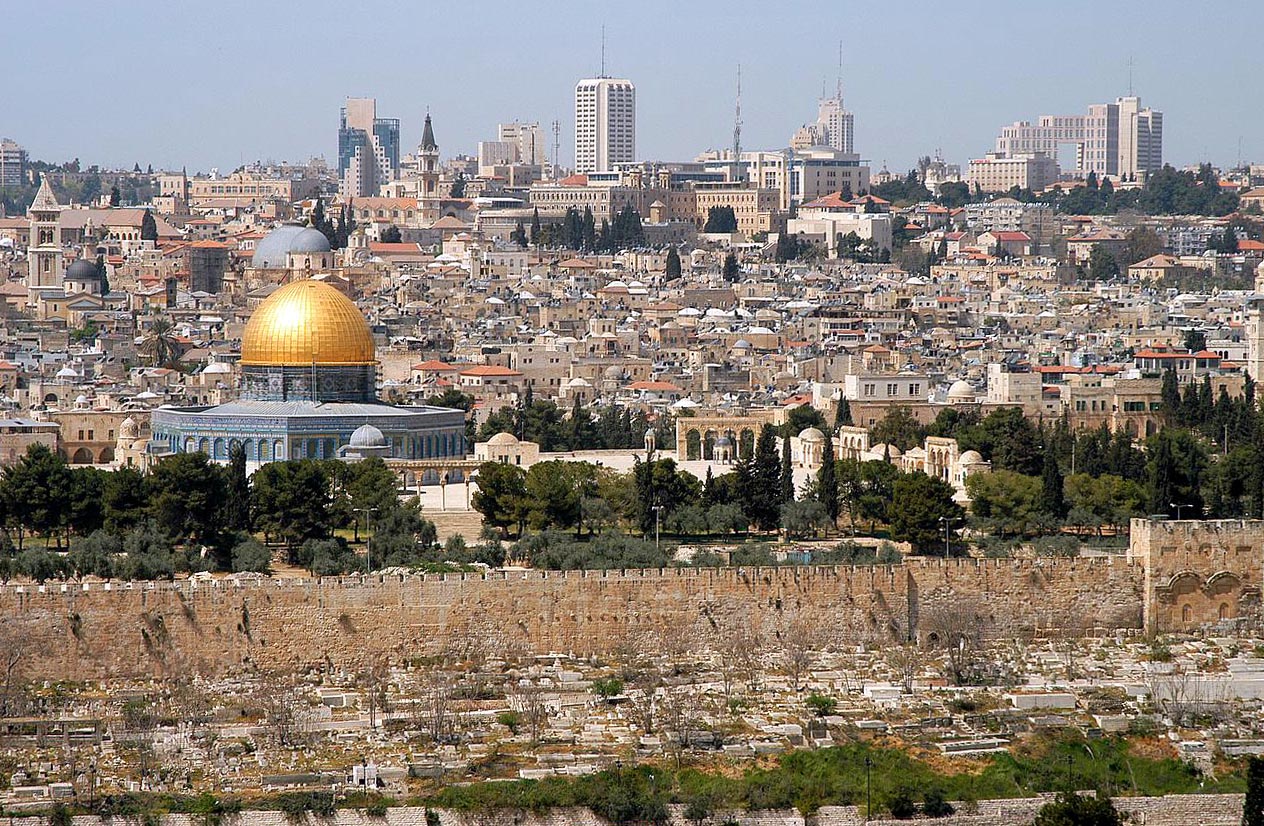
After fifty-five minutes we arrive at the Hyatt Regency, on a hill north of the Old City. From windows in the expansive lobby we can see the Dome of the Rock and and the temple mount. I am really here! Dinner at seven, followed by journal writing, and then my twenty-eight hour day is done. Early to bed, for early we were to rise the next day.
The land of Israel is very small; about sixty-five miles wide and about 200 miles long. If you get out a map of the United States, go the the western part of the country and find the state of Utah; you can imagine three lands of Israel sitting comfortably inside its borders.
There are virtually no natural resources, no gold or silver. The feisty Golda Meir, one time Prime Minister of Israel, once chided Moses, "He traveled the wilderness for forty years and then settled the one spot that had no oil!" Yet the land has been conquered many, many times -- almost thirty different times by at least nineteen different peoples. Why, if there are no natural resources? Because the land was the crossroads of the East.
Meanwhile the Jews and Arabs, who have experienced these various conquests are still there, having survived, submitted to, or eventually overthrown the conquerors. The Jews and Arabs view this land as their home. Yet no legitimate Jewish or Arab government has called it exclusively their own. For the most part they have coexisted for centuries.
Contrary to popular perception the majority of Jews and Arabs desire to live peacefully with each other. Perhaps it is like the colonists during the American Revolution -- one third in favor, one third opposed, and one third indifferent -- one third knowing and peacefully living amongst each other, one third bitterly opposed to living amongst each other, and one third pulled between the other two thirds.
The geography also provides many contrasts. Israel is a land of ocean, seas, plains, forests, deserts and mountains. It is green and there is water. It is a good land, where Jews, Moslems, and Christians raise their families. Most of them agree the land is ripe with a feeling of peace and youthful energy.
This was in 1999, before the peace process fell apart, before the violence rose to take center stage. The modern state of Israel has had to contend with terrorism for most of its seventy year history. Even so, in 1995 Israel had less violence (crime) than Salt Lake City, Utah, did. Until the collapse of the peace process the terrorism and violence were but isolated incidents.
At least, this was the perspective of our tour guide. He was born of Jewish parents in Haifa in 1941. After a divorce his father took him to the United States. While there father and son joined the Church of Jesus Christ of Latter-day Saints - not converted, mind you, for they still had their Jewish heritage. In the 1970s our guide returned to live in Israel and start a tour company. Over the years he has developed friendships and business relationships with Arabs, Jews and Christians.
In December 1998, my mother invited my wife and I to a Christmas concert at Temple Square in Salt Lake City. Before the concert, over dinner, my mother talked to us about her desire to go back to Israel for another tour vacation. It is said that when you visit the Holy Land you have a desire to visit again; my mother had visited Israel a few years previously, and her desire to return again was indeed strong.
However, based on that trip and on another she had made to the British Isles, she knew that she would need some travel companions. She had some health concerns did not want to be a burden on other travelers in the tour group. My mother then invited my wife and I to accompany her to Israel in the coming spring.
We were stunned. Neither of us had expected such an opportunity to tour the Holy Land at that point in our lives. Many desire to go to Israel yet never have the opportunity, and here one was being handed to us on a silver platter. We eagerly accepted my mother's offer.
We booked a tour with a company called Israel Revealed and our tour guide would be none other than Daniel Rona, who at the time was the only licensed LDS guide in Israel. A few months before the trip, we attended an orientation meeting at Israel Revealed's Utah offices where we were given tips and materials with which to prepare for the trip. We were counseled to take daily walks in order to prepare physically.
On April 11, 1999, a Sunday, we flew out of Salt Lake International Airport on the first leg of an 18 hour journey to the Holy Land. It seems so hard to believe, but 20 years have passed since that trip of a lifetime. Like my mother, my wife and I have desired to return, but there are times when I am not sure we will ever have that opportunity. To mark the this anniversary, I will be sharing some stories from the trip.
My wife had never been on a big jet airliner before, and she took some motion sickness tablets and hour before our scheduled departure. She squeezed my hand as we taxied, took off and banked onto an eastern course. I talked her through it, and she found that it was not bad at all.
Our first layover was in Cincinnati, Ohio, where we landed at 6:00 pm eastern time. We were on our way to the gate for the next flight -- at the other end of the terminal -- when I realized that I had left my camera bag on the plane. I ran back to the gate we had just exited, and I was allowed back on the aircraft, but my camera was gone. At the desk by the gate they told me that a flight attendant had found my bag in the overhead and had someone take it to the gate for our next flight.
They found my wife and gave her my camera, and she had them page me. I heard the page when I was about halfway back to the gate. After a ten minute wait, we boarded our next flight. We had a longer wait on the taxiway as we were slated as number four for takeoff.
We spent the night flying over the Atlantic. After watching a couple of movies, I found that I could not sleep. It was after 10:00 pm back home, and dark outside, but sleep was elusive. Not long after sunrise we flew over the beaches at Normandy and then south of Paris.
When we landed in Zurch, we had just enough time to walk from one end of the terminal to the other and board our flight for Tel Aviv. We were rushed, yet there seemed to be time as we waited to board for a quick trip to the restroom. I was wrong, though, as I found them holding the flight for me when I made it back to the gate -- mind you, they had already been holding the plane because our flight from Cincinnati had been stacked for twenty minutes before landing. Even so, we were the last three passengers to board.
This leg would be on a Swiss Air flight, and we were jammed in like sardines. I heard rather than saw the in-flight movie. I asked for the lasagna for lunch but got the turkey dish instead. It was not a pleasant flight. The man sitting next to me was a little inpatient when I asked him how to fill out a customs form -- I was the dumb American who was responsible for delaying departure a few extra minutes just so I could use the restroom, after all.
As a little history lesson, this was April of 1999, when NATO was conducting a bombing campaign of Yugoslavia over a humanitarian crisis in Kosovo. Because of this, we had to fly further east before proceeding south to the Mediterranean Sea, adding many miles and an extra hour to the trip.
After the movie, we were soon on our final approach to David Ben-Gurion International Airport. The arrival terminal was not very modern, leaving us to exit down the stairs to board a shuttle to the terminal itself. There we found several long lines for the gates where we would present our passports.
My mother was a little confused about which line to stand in; suddenly she walked off to one side of the room and disappeared behind the passport booths. By the time I got to where I last saw her, she was nowhere to be seen. I was dumbfounded. The only thing I could think to do was to pick a line and wait our turn. I think my mother must have had the right idea, though, because once we finally got through, we found everyone from the tour group, including my mother, waiting for us.
We blew right through customs -- nothing to declare -- and boarded a tour group bus for the ride up to Jerusalem. Once more, though, we had to wait form group members flying in from London. After twenty minutes we were on our way into the unexpected.
Over a year ago I wrote a post cataloging the difficulties I had experienced in the 2016 and 2017. I wrote that I felt at times that I was forsaken and alone, yet as I recounted the challenges I had experienced, I found that I had received needed help.
See: There is Always Hope
It might have been reasonable to expect, then, that 2018 should have been better, yet it was not.
After a few years of unemployment or underemployment, I still had a steady job, which was good, and that job had previously given me the opportunity to be a trainer, which was awesome. Trainer was a great thing to put on the resume, and I wondered if I should not try to find a better job. But I wanted to be a trainer again -- because, again, it was a blast, and also to beef up that part of the resume -- so I stayed.
In the spring I interviewed for a promotion to permanent trainer. Part of the interview process involved giving a presentation, to demonstrate skills in front of a classroom. I thought I gave a great presentation, but they didn't think it was hands-on enough. There were three spots open, and I finished fourth in the running -- and the margin between three and four was paper thin.
As I thought about what I could have done differently, and not being able to think of anything that involved actual hands, I decided that next time I would repackage it as a minds-on presentation, selling it as an exercise in analyzing verbal and visual information -- which happens to be a useful skill in a call center.
It was either the same day I heard I didn't get the promotion or the day following when I went for a walk on main street in my smallish town. I was trying to listen to an audio book on my earbuds, but was distracted by the not getting a promotion thing. Suddenly I saw an old high school friend up ahead, walking toward me.
This friend and I had had a falling out of sorts a few years ago. She showed up at a social media site I had been at for a few years and when I sent a friend request, she unexpectedly blocked me. But it took a few months for me to realize it. I didn't know if there was a problem, I didn't understand why, but I tried to find a way to communicate with her and apologize for anything I might have done. Eventually I was able to do that through a mutual friend: the only response I got back was that I was forgiven, but that she did not want to talk. She also said that I should just move on. Move on from what? Frankly, this didn't really feel like forgiveness.
A couple of years later, the father of a different mutual friend passed away. I knew there was a very good chance I would see her at the funeral, and I did! I found a place to sit, looked up, and there she was sitting two rows in front of me. The person she was sitting with saw me, but she never turned around to look, and after the service she got up and walked out without ever turning her head. It was surreal!
I saw her next at our 30th high school reunion in 2017. As the reunion was approaching, I felt like I was becoming a basket case, stressing about how she was going to react if and when she saw me. At the reunion, most of the evening passed without our being in close proximity, though I was very aware of her presence on the other side of the large room. Finally, before leaving, I maneuvered into a position where she would be sure to see me -- because I had to know what she would do. We just looked at each other for a moment, no words were exchanged, and then she turned and walked away.
The next day, I talked with the same mutual friend who had acted as go-between before, wondering if I should try to make a peace offering. She talked me out of it, but then got a call from our friend, and on her own initiative broached the idea of a peace offering. The answer from my old friend was that the offering was not necessary, that there were no hard feelings. I decided that this would have to be enough to give me peace, and I figured I probably would not see her for another ten years, anyway, until the next reunion.
But now, several months later, here we were on Main Street, approaching each other. She must have seen me first, because she had her hand up by her eye -- like you do when you don't want someone to see you. It all happened so fast, and I was so distracted by not getting the promotion at work, that at first I told myself it might not have been her. I tried to tell myself it was only 50-50, but as time passed, and I thought less about not getting the promotion, the more certain I became that it was her -- there had been no wind, and we were in the shade -- the only thing that made sense was that she was trying to hide from me.
By small and simple things, great things can be brought to pass, but also not so great things. We have no idea how much good we can do with a kind word or a smile. At the same time, we have no idea how a much damage we can do with a careless word or a simple joke, even a simple act of omission.
The promotion, this encounter on Main Street, were like a one-two punch; I have felt as though I were torn asunder. It has been a battle ever since, sticking it out at a job that is often frustrating, and feeling rejected by someone I thought of as a best friend in high school. I started, again, to question everything about myself and about friendship. Yes, I was hurt, and I didn't understand why she did what she did. But I was trying not to hold a grudge, and so I turned the anger onto myself.
I felt so much shame, what could I have done that led my old friend to cut me out of her life? This person I admire so much has, it seems, a smile for everyone but me. I wondered, what small and simple thing had caused her so much pain that after several years she still could not acknowledge me; wondering brought more shame.
This became a struggle of many months; I could find no solace, no peace, even when turning to the scriptures or attending church meetings. One day I read one of my favorite chapters in the Book of Mormon, Moroni 7, but instead of finding serenity, I felt my heart break.
Then I saw a quote from President Thomas S. Monson: "Blame keeps wounds open. Only forgiveness heals."
This was distressing. I didn't think I needed to forgive because, I told myself, I was not carrying a grudge. I was not thinking angry thoughts about my old friend, I was not hoping for bad things to happen to her. I had prayed for my friend, that she might have peace -- I had even prayed that God would send her ministering angels. Yet there I was, where I had been for a long time, in the depths of despair.
Finally I said, "[My friend], I forgive you." And peace gradually enveloped my soul.
Rather than this being the end, it was only a beginning. I found that I had to keep forgiving; as time wore on, the doubts and the frustration would return, so again I would say "[My friend], I forgive you."
I could find peace, for awhile, but my heart was not healing. Even so, though I felt alone and forgotten, I was not. Even in 2018, there were moments when I experienced genuine friendship from others. Such moments have seemingly become more common in 2019.
I have truly been blessed in recent months by friends both old and new. I felt forgotten for so long, but not anymore. Genuine compliments and genuine kindness have managed to counter rather effectively the many doubts I had over previous months and years.
I may even have had a breakthrough recently when I realized that, while everything might not be perfect, there are good things happening. I have had worse jobs than the one I currently have --
which has been a steady job for approaching four years -- and I am getting by financially.
Perhaps more importantly, the friends I do have matter much more than any friends I might not have or not have any longer. All that negative stuff I have been spending so much time thinking about, I don't have to keep doing that. It is time to let go and be happy.
By looking to the lighthouse of the Lord, by counting my blessings, by forgiving, but also importantly, by the blessing of true friendship, I have found peace and, finally, my heart is beginning to heal.
Throughout 2017 I made a series of posts here regarding the my high school years. The stories centered around the junior prom and the three girls I asked to each of the dances during that period. Some day I might put those stories in a book, but for now, here are the links to those posts collected all in one place:
Series 1: A Prom Story
Past is Prologue
The story actually begins almost two years before the first Junior Prom, when I went to a stake dance and tripped the light fantastic for the first time with Julie. Over the next 18 months there were more dances, and soon I was experiencing feelings of attraction.
http://goodtidingsforus.blogspot.com/2017/02/a-prom-story-past-is-prologue.html
A Natural Thing
I was now a sophomore in high school, and Julie sat in front of me everyday in one of my classes. These were magical days, when everything was wonderful, and I believed I was falling in love.
http://goodtidingsforus.blogspot.com/2017/02/a-prom-story-natural-thing.html
"We've Got Tonight"
After finally turning sixteen I asked Julie to the Junior Prom. Julie was radiant that night, and for me it was an enchanted evening.
http://goodtidingsforus.blogspot.com/2017/02/a-prom-story-weve-got-tonight.html
After the Fall
In the months after the prom I bounced around between hope and despair. I asked Julie out a few times, only to be rebuffed. I would try to forget about her, but then a brief encounter would suggest the possibility that she might still like me.
http://goodtidingsforus.blogspot.com/2017/03/a-prom-story-after-fall.html
Series 2: Prom Story
New Beginnings
With my love for Julie unrequited, I met a new girl, a sweet angel. But this time I would be more careful, this time I would build a solid friendship before I asked her out. As my junior year began, I had a plan to be more outgoing, and this led to meeting many new friends.
http://goodtidingsforus.blogspot.com/2017/06/prom-story-new-beginnings.html
The More Things Change
This is the one where I win the award for overthinking. Over the Christmas break I asked Mary to the junior prom, but on New Year's Eve I was strangely flooded with thoughts about Julie.
http://goodtidingsforus.blogspot.com/2017/06/prom-story-more-things-change.html
She First Said Yes
Mary waited several weeks before finally saying yes, but the next night she called to cancel. My heart was broken, but I accepted her choice. This would lead me to make a major life decision.
http://goodtidingsforus.blogspot.com/2017/06/prom-story.html
The Winter of My Discontent
In the aftermath of the prom I didn't go to, I had to find a way to deal with my feelings for Julie, and my heartbreak over Mary's decision to cancel our date. I talked with both girls, and in one case we became better friends.
http://goodtidingsforus.blogspot.com/2017/07/prom-story-winter-of-my-discontent.html
Series 3: Prom
The Third Girl
I had met Evelyn during the fall of my junior year, and by the next spring our friendship had progressed to point where I could have fallen for her. But I had made a decision to wait until after my mission to have a girlfriend. Even so, Evelyn would become one of my best friends.
http://goodtidingsforus.blogspot.com/2017/07/prom-third-girl.html
It Could Have Been You
Meanwhile, just being friends with Julie proved to be a challenge. This time we were both stirred up, and as winter approached, the storm broke.
http://goodtidingsforus.blogspot.com/2017/07/prom-it-could-have-been-you.html
"Just For a Moment"
Even as the storm raged, I asked Evelyn to the junior prom. The evening started out well enough, at least until we walked into Symphony Hall, the same venue for the prom two years earlier.
http://goodtidingsforus.blogspot.com/2017/07/prom-just-for-moment.html
"No Man Is An Island"
While Julie and I debated what a friend was supposed to be, I began to wonder at the very meaning of friendship. At times, I may have expected too much from my friends, but at other times I doubted that I had a right to any expectations at all.
http://goodtidingsforus.blogspot.com/2017/07/prom-no-man-is-island.html
A Two Part Interlude: The Ball
New Perspectives
Even as I struggled with feelings of loneliness during the winter of my senior year, my perspective began to change. Somehow, things got better.
http://goodtidingsforus.blogspot.com/2017/08/the-ball-new-perspectives.html
Creating Memories
I asked Gabrielle to the Senior Ball, and we both had a wonderful time.
http://goodtidingsforus.blogspot.com/2017/08/the-ball-creating-memories.html
Series 4: After Prom
The Unicorn
The summer after I graduated from high school, Julie's family moved away, and only then did I find peace. Years later someone suggested that Julie had been my unicorn.
http://goodtidingsforus.blogspot.com/2017/08/after-prom-unicorn.html
Angels
If Julie was my unicorn, Mary was my angel. As it turned out, however, there were other angels in my life.
http://goodtidingsforus.blogspot.com/2017/08/after-prom-angels.html
Paragon
I had made a mistake in high school when I put my new found friends up on pedestals. Evelyn had become one of my best friends, and her pedestal became the tallest.
http://goodtidingsforus.blogspot.com/2017/09/after-prom-paragon.html