Sunday, September 15, 2019

Jerusalem 1999: From Bethany to the Mount of Olives


Two miles east of Jerusalem is the town of Bethany, and it was our first stop on the morning of Monday, April 19, 1999. The word Bethani means "house of the poor," and there are still many honorably poor people living here.

We visit the home of the widow Abu Issa Mukhal, a Moslem married to a Christian woman, Shifa. She lives in a small room, built many years ago by the Crusaders. In this room, that is smaller than my living room, she faithfully raised eight children. An additional room and a kitchen hut has been added in recent years. At last count some twenty-eight grandchildren assemble here almost daily or weekly. There is one full time job and some part time jobs to support them all.

This small room is across the street from the entrance to Lazarus' tomb. To the left are two Christian churches and to the right is a Moslem mosque.

Our guide takes me aside asking me to help him with something. He leads me down a narrow, steep, and not very well lit stairwell to the mourning chamber and the tomb. I hide in the tomb itself while he calls the rest of the group down to the mourning chamber. I had to step down into a passageway and I slipped on the last step.

Once gathered the group reads through the account of the raising from the dead of Lazarus by Jesus Christ (see John chapter 11). When our guide reads "Lazarus, come forth" I crouched through the passageway, suddenly appearing from the tomb to the surprise and enjoyment of everyone. On the way back up the stairs I noticed immediately that I had pulled a muscle when I slipped on that step entering the tomb.


Our next stop was the Old City, again through the Dung Gate. We visited the Western or "Wailing" Wall where we witnessed a young boy singing his Bar Mitzvah. We also learned about ancient temple practices.

The men of the group got the better part of the deal because men and women worship in different sections. We were able to go under Wilson's Arch, excavated remains of a bridge that led from Herod's palace to the Temple itself. Today this arch, now more of a tunnel under the city, houses a worship area for Jewish men wishing to be as close to the Holy of Holies as possible. Women are allowed to worship in here on rainy days. Various "arks" containing Torah scrolls are also kept here. Three times a week male worshipers come and collect the scrolls for Bar Mitzvah readings (singing in many cases, actually) or Sabbath readings.

In the wall itself there is also evidence of a very old custom. Here and there one can see nails pounded into the wall. Tradition and older texts reveal the custom of the "sure nails." People would bring there sins or grief to the wall and "nail" them in a sure place. The nails are a reminder of Isaiah's prophecy that man's burden will be removed when the nail in the sure place is taken down.

Bits of paper are also stuck in the cracks of the wall. More secular Jews have started to write prayers or wishes on paper and stuff them into the cracks. Today one can even fax or e-mail a prayer to someone nearby who will stuff it into a crack for you. Some papers contain lists of names of people needing special prayers and are placed there by orthodox Jews.

It is said that non-Jews call the Western Wall the "Wailing Wall" because they may have mistaken the prayers as crying or wailing. This worship area is only a remnant of the entire Western Wall, and Jews gather here to worship because they believe they have no priestly permission or authority to go on the Temple Mount itself. The wall simply serves as the closest gathering spot available and somewhat satisfies their yearning to connect with their past.

The Western Wall has been desecrated by Moslems throughout the centuries, including the period from 1948 to 1967 when Jews were forbidden to enter the Old City or worship at the wall. Huts and hovels crowded the area below the wall, and a portion of the wall was used for public toilets. After the liberation in the Six Day War of 1967 the area was cleared and restored. The Jews have kept a constant vigil ever since and at any hour of the day or night one kind find someone praying or reciting scriptures at the wall.

Our guide informs us that some years ago there was a riot on the Temple Mount between Arabs and Israeli Policemen, much like the one that followed the visit of Prime Minister Sharon in 2000. The riot was reported that night by the international media. However, the international media failed to report that Arabs had been throwing rocks down on the worshipers at the Western Wall, thus prompting the Israeli Police to send officers to the Temple Mount in the first place.


Our next stop is in what was the Upper part of Herod's Jerusalem, it is now just outside the walls of the Old City. Here there is a room considered to be the traditional site of the Last Supper. A second story room, it was built some eight hundred years ago. In reality, the word "upper" may have referred to a room in the Upper part of the city rather than a room upstairs. The Upper part of Herod's Jerusalem was where the priests generally lived and was considered the upper class section of the city.

We take a seat on the floor and relive both the Last Supper, by reading from the Bible, and a traditional Passover meal. In ancient days the Seder table was set up in a U-shape with participants sitting on the outside. The master of the house, or the oldest male, would sit second from the right end looking inward. The oldest would then select a boy, usually the youngest, to sit on his right and assist him in the order (Seder) of the meal and ritual customs. At one point the boy is to sing "What makes this night different from any other night." Opposite the boy, the last seat on the left remains empty and thus available for Elijah. Through the entire meal a door is left open for Elijah, who, by Jewish tradition, would announce the coming of the Messiah.

Modern day preparations include bitter herbs that are symbolic of bondage; there is also a mixture of chopped fruit, nuts, cinnamon, and honey that represent deliverance; parsley or watercress is used as a token of gratitude for the earth's abundance; salted water or vinegar is set out for cleansing use; there is a lamb's shank bone to remind of past sacrifices and an egg which is reminiscent of a sacrifice and new beginning. These and other foods are eaten symbolizing the deliverance from Egypt. Wine is prepared and used four times.

Then there is the unleavened bread. In the week before Passover all the leaven, yeast, and other items that might sprout are removed from the house. A tradition still followed in modern Israel is that the leaven must be "sold." The chief rabbi arranges to sell the entire country's supply of grain, prepackaged breads and leavened products to a non-Jew before Passover begins. In this way, whatever leaven is still around does not really belong to the Jews. The deal usually involves a down payment with delivery to be made when the balance is paid. Somehow the buyer never gets around to paying off the balance and by default "ownership" is returned to the Jews after Passover.

In the Seder, there are three times when the wine is blessed and sipped. Following each sip, a piece of unleavened bread is used. Each piece is blessed, broken, passed and eaten. There is a total of three pieces of bread, but they are used four times. Toward the beginning of the Seder the middle of three pieces is broken in two. One half has to be hidden away, usually in an upper part of the house, or above something. In at least one tradition, the half piece is wrapped in a red cloth before being hidden. The piece will be found later by children and it will be used with a fourth cup of wine.

Considering the Jewish calendar and the scriptural narrative, Jesus led the Passover meal with his disciples on the preparation evening/day, the Passover really began the following evening. This high, holy week always began on the first full moon after the first day of spring. Every year that day becomes an extra Sabbath that week; it is called a High Day. That High Day can occur on any day of the week, including the regular Sabbath. Perhaps, then, we should be celebrating Good Thursday instead of Good Friday.

Jesus did some other significant things at that Passover meal. At one point he changed the order of the wine and bread with the bread first. Jesus also demonstrated his role as servant by washing the feet of his disciples. Then he gave them a new commandment "That ye love one another, as I have loved you. . . ." (See John 13:34)

Our group now concludes our time in the Upper Room by singing a hymn written by Luciane Clark Fox:

As I have loved you, Love one another.
This new commandment:
Love one another.
By this shall men know
Ye are my disciples,
If ye have love one for another.


Chiasmi are word games with subtle meanings, they are words listed in inverted repetitions or in opposites. One can find many a Chiasmus in the Bible. Returning to Jaffa and Acts chapter 10, for a moment, we can find one.

We read first of the dream Cornelius, a gentile, had telling him to send for Peter in Jaffa, then we read about Peter's dream where he is commanded to eat non-kosher food by an angel, then Peter arrives in Caesarea and we read again about Cornelius' dream. In the center, of course, is Peter's dream, the point of which was to tell Peter that he was now commanded to teach the gospel to gentiles because the salvation Jesus' atonement gives is available for everyone.

On the Mount of Olives we find another Chiasmus with the tradition of sacrificing a red calf (whose ashes were used for the purification of sins) on the mount, then Jesus bleeding from every poor as he took the sins of all mankind upon him in the Garden of Gethsemane, and, finally, in the prophecy that Jesus will appear on the Mount of Olives in the last days wearing red clothing. In the center is the atonement of Jesus Christ.

After leaving the Upper Room in what is now called Mount Zion, we went over to the Mount of Olives. There we find an orchard of olive trees. From here we can line up the Golden Gate (the Gate Beautiful) with the Dome of the Tablets on the Temple Mount. Here we sit and read the accounts of Jesus in the Garden of Gethsemane.

Today there are several traditional churches on the Mount of Olives: Russian Orthodox, Greek Orthodox, and Catholic. The garden of the Catholic Church has had olive trees existing for the better part of twenty centuries. The garden mentioned in the scriptures was Gethsemane, a word that means a "wine press" or "olive press," usually found in a vineyard or orchard. There are many such orchards on the Mount of Olives today.

The agony that Jesus went through became so difficult that he prayed to his Father for relief, yet submissively said "thy will be done."

"And being in an agony he prayed more earnestly: and his sweat was as it were great drops of blood falling down to the ground" (Luke 22:44).

It seems that his clothing must surely have been stained red.

As we sat in this peaceful orchard we had a picnic lunch, those pocket things again. The feeling of peace was so strong and sweet, we just didn't want to leave.

But leave we must, after reading about the betrayal of Jesus by Judas, we head over to the Palace of Caiaphas, where Jesus was taken that fateful night.

Thursday, September 5, 2019

Jerusalem 1999: Mount Moriah


Friday is the Moslem Holy Day and Saturday is the Jewish Sabbath, therefore, the weekend in Israel is Friday and Saturday and the first work day of the week is Sunday. Many Christians have adjusted their Sabbath to Saturday as well, and that was the day we went to the BYU Jerusalem Center for Sunday services. Part of a Church of Jesus Christ of Latter-day Saints service is the partaking of bread and water, representing the body and blood of Jesus Christ. As we partake I am struck by the fact that I am doing this in Jerusalem, a few blocks away from Gethsemane. It is a powerful feeling.

On Sunday, April 18, 1999, it was back to a full day of touring. We started by passing through the Dung Gate into the Old City. We followed a long straight path, through a security checkpoint and up to the Temple Mount. To our left, and below, worshipers are gathering at the Western Wall. In front of us is the Al Aksa Mosque. We are required to remove our shoes and leave all of our belongings outside. Inside we see a large room with two rows of pillars, and on one pillar you can still see the bullet marks from the 1956 assassination of the King of Jordan (the current king's grandfather).

As it was explained to me, Islam was started nearly six hundred years after the time of Christ. It was founded by Mohammed who saw both Christianity and Judaism as apostate religions. They had only a portion of the truths which he believed he had received from the angel Gabriel during his "Night Vision." It was in this dream that he was transported from the rock that is now under the Dome of the Rock. The Islamic religion incorporates various tenets, stories, and doctrines of both Judaism and Christianity. Islam is the name of the religion, and Moslem means "a follower of Islam."

The Islam book of scripture is the Koran, wherein it is clearly stated that the people of the "Book" -- meaning the Bible, which are the Jews and the Christians -- are to be protected and valued as friends of the Moslems. The Koran is a collection of the sayings of Mohammed as he was instructed by the angel Gabriel.


Due to the diversity of the Moslem population, many political leaders have used the mosque as platform for their ideologies. The euphoria of these political movements is thus connected to the religious environment and many followers accept political concepts as religious doctrine. The Five Pillars of Islam are:

1) Worshiping of Allah (Allah is a singular/neutral word and the Arabic way of pronouncing Elohim, which is a Hebrew plural/masculine word);
2) Praying five times a day in the direction of Mecca, preceded by a ritual washing;
3) Paying tithes and offerings for the poor;
4) Fasting for a monthly period during the daytime every year (Ramadan);
5) The pilgrimage to Mecca once in a lifetime.

Mecca is the first holy site of Islam and the birthplace of Mohammed. Nearby Medina is the second holiest site, and is where Mohammed is buried. Mount Moriah is the third holiest as the site of the rock from which Mohammed dreamed he rose to visit heaven.

The Al Aksa Mosque was built in 701 A.D. (or C.E.) and has undergone at least four major renovations. Ten years earlier the Dome of the Rock had been constructed. We now exit the Mosque and reclaim our belongings, then we head up some steps and pass under an archway into the area of the Dome. There we must again remove our shoes and leave our belongings before entering.

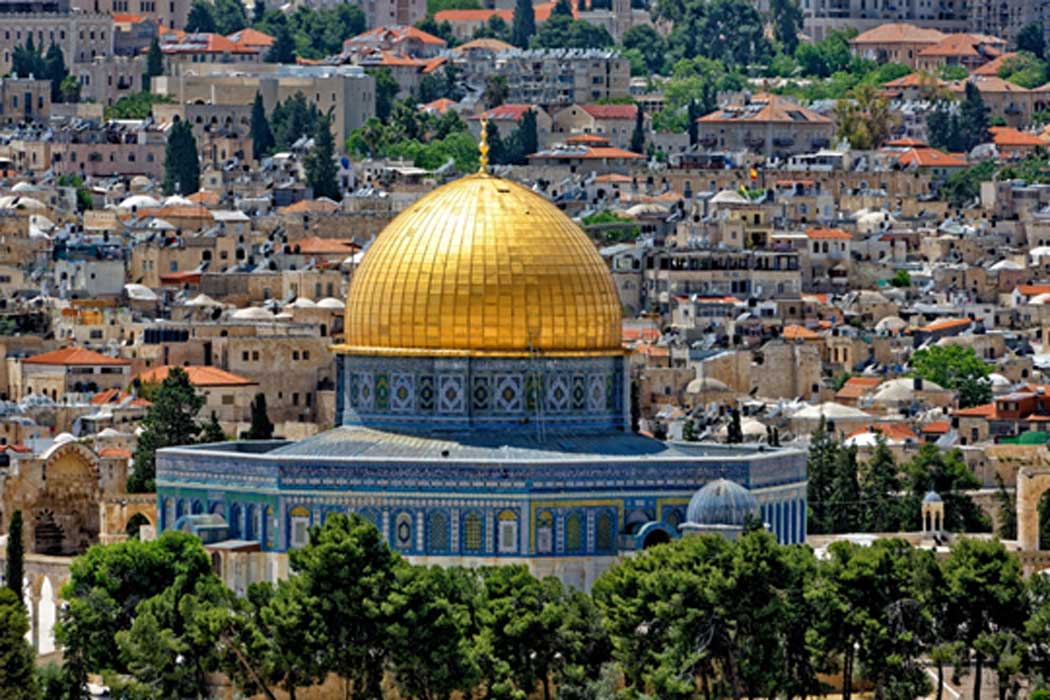
The Dome of the Rock, unlike mosques that are always directed towards Mecca, has eight sides that symbolically face out in every direction. It is suggested that the Dome draws attention to heaven. In the center of the building, under the dome, is, of course, the rock that Mohammed dreamed about.


While on Mount Moriah we also talked about the Jewish temples, more specifically the possible location of the Holy of Holies. There are numerous domes and cupolas on the Temple Mount, and a little bit north of the Dome of the Rock is a very small dome called the Dome of the Tablets, it is built over a small section of bedrock. Recent archaeological studies suggest that this could have been the site of the alter of Holy of Holies in the Israelite temple. Theoretically, then, it would be possible to rebuild the temple on this spot without disturbing the Dome of the Rock, and there are prophecies which suggest that the temple will be rebuilt.

According to the Bible and to Jewish customs, there was a temple ceremony involving the sacrifice of a red calf (see Numbers 19:2-10). An unblemished, first born red calf was led from the temple out through the Gate Beautiful and up the Mount of Olives. It was then sacrificed high enough to be over the temple but also in-line with the the Gate Beautiful and still northward of the alter of Holy of Holies. When one stands today on the Mount of Olives they can line up the Gate Beautiful with the Dome of the Tablets.
Additionally, it was on the Mount of Olives, in the Garden of Gethsemane that Jesus bled from every poor, and according to prophecy Jesus will reappear in the last days on the Mount of Olives wearing red. He will then pass through the Gate Beautiful and up to the temple.

The question, then, is if the current Gate Beautiful is in the same spot as the original gate. One day some years ago, an archaeologist, Dr. James Flemming, was photographing the Gate Beautiful from a spot directly in front. As he was moving around he fell through a grave. When the Turks occupied Palestine they put graves in front of the Gate beautiful believing that this would discourage the Messiah from entering the temple area since Jewish priests are not allowed to walk where the dead are buried. Anyway, After falling through a grave, Dr. Flemming found himself in a large grave room, and he could see that the wall directly underneath today's gate had once been a gate as well. It had been filled in as a foundation for the newer gate above.


At this point we left the Old City, again through the Dung Gate, and our bus took us to the Israel Museum. Here we spent several hours, or so it seemed, looking at artifacts of Jewish worship and from thousands of years of history. The museum has its own web site for those interested.

After lunch at the museum we visited the Shrine of the Book, on the same campus, where some of the Dead Sea Scrolls are displayed in cases where the humidity, temperature, and light are controlled.

After this we ventured out of Greater Jerusalem down the Bab El Wad canyon. During the 1948 War of Independence the Arabs had blocked this canyon as part of the siege of Jerusalem. The Israelis built a rather precarious route through another nearby canyon. The media was quick to dub it the "Burma Road." American volunteer Mickey Markus engineered the road and was then accidentally killed on the day of its completion. Later a motion picture, Cast A Giant Shadow, was made about the "Burma Road."  I found this movie on DVD a few years ago; it's very good, with Kirk Douglas in the starring role.

We stopped at Bet Shemesh where much of the Samson episode took place. From there it was over to the Valley of Elah where David slew Goliath. We all tried to throw rocks with the type of sling David used. Many rocks went behind us instead of ahead.

We stopped again, on the way back to Jerusalem up another canyon, at the site of an excavation. Our guide uncovered an ancient tile floor below the sand. After that we replaced the sand so that another group could "find" the tile. It is a major Federal crime in Israel, with severe consequences, for anyone to vandalize or destroy a historical or archaeological site.

Once back in Jerusalem we stopped at the National Diamond Center for a brief tour and some free samples. At that the day was done.


Wednesday, August 7, 2019

Unsolicited Advice


While serving in my first area on my LDS mission, I experienced some adversity with my companions and an area where the work was extremely slow. Feeling a need for some encouragement, I wrote some letters to friends back home. One friend wrote back, but it was not the kind of letter I was hoping for. My friend wrote that she wanted to be helpful but that she felt she had to be honest -- clearly, she also felt that I needed to understand a few things. I had wanted some kind words, instead I received some unsolicited advice.

It can be easy to find fault and weakness in others, and when they ask for our help, it may seem like a good idea to inform them of our findings. There may be cases where this is appropriate, especially if the individual asks for complete, brutal honesty, but in most cases we may do more harm than good, despite our best intentions. We may do well to remember the words of the hymn:

Should you feel inclined to censure
Faults you may in others view,
Ask your own heart, ere you venture,
If you have not failings, too.
Let not friendly vows be broken;
Rather strive a friend to gain.
Many words in anger spoken
Find their passage home again.

My intent here is not to criticize my friend; maybe she did not need to write some of the things that she did, but I did not have to internalize them in the way that I did.

I felt, at the time, that her letter was the slap upside the head that I needed, and over the next few years, any time I felt I needed another head slap, I would pull out that letter. That was my mistake, and it served to magnify some of the feelings I had in high school about my friends. They were cool, they were special, and I was anything but those things. I was quiet, plain, even socially inept -- so I thought -- and I had other weaknesses.

When I was young I felt that I did not fit in anywhere. At school I was the kid everyone, it seemed, made fun off, and this spilled over to the neighborhood I lived in and to the ward I attended. Additionally, I felt at times that I did not fit in my own family because I seemed to be so different from my three brothers. To this day I much prefer to interact with women instead of men; I was never one of the guys, and never knew how to be.

I made a lot of friends in high school, but most of them lived in other parts of town -- a large gully literally separated my part of town from theirs -- and had gone to different elementary and junior high schools. At first I was happy to bask in the light of my new friends, but eventually it seemed that my quiet nature was keeping me separate from them. I wondered how I fit in, or if I did at all. Even today there are times when I feel that I do not fit in anywhere.

I am still quiet and still an introvert. I value my alone time; I can spend hours just reading a book, or walking around taking photographs. But there are times when I desperately want to be around other people, and there just isn't anyone to be around. Still other times I am with people and I just can't think of anything to say; it gets awkward and I start thinking that I am better off just being alone. It's a vicious circle, and it leaves me feeling even more isolated and alone.

A song I have been listening to recently is about dealing with unsolicited advice:

You've got opinions, man
We're all entitled to 'em, but I never asked
So let me thank you for your time,
And try not to waste anymore of mine. . . .
I hate to break it to you babe, but I'm not drowning
There's no one here to save
Who cares if you disagree?
You are not me. . . .
Who died and made you king of anything?

But then there is this:

All my life I've tried to make everybody happy
While I just hurt and hide
Waiting for someone to tell me it's my turn to decide

I don't think that I have tried to make people happy, simply because I never thought I could. I was no one, an outcast, what could I do? Meanwhile, there have certainly been times that I have gone deep and run silent. Now I am beginning to realize that I have been waiting for someone to tell me that it is okay for me to just be myself.

I learned a lot on my mission -- it was a university of life -- and when I came home I wanted show my friends that I had changed. Instead, I found myself being unsure of how to act around my friends, afraid of being the same socially inept kid I perceived myself to be in high school. I was afraid to simply be myself because, whoever that was, had been so deeply flawed.

A few years ago, the friend who had written the letter with the unsolicited advice joined a social media website, and when I reached out, she blocked me. As hard as that was, it did serve one purpose in showing me that at least some of my friends were not quite as special as I thought they were. In realizing that, it allowed me to also discover that there had been something special about me. I finally took all my friends down from the pedestals I had placed them on.

Only then could I truly understand that God did not just give weaknesses to me, but to everyone. He gives us weaknesses that we might be humble, and if we humble ourselves before him and exercise faith in him, he will make weak things become strong, because his grace is sufficient. Yes, I had weaknesses -- I still do -- but so did my friends, and if, with their weaknesses, they could be special, then so could I.

Ironically, my friend's letter so long ago also contained some of the best advice I ever received, and this is a good place to remember it: Everyone has down times, everyone experiences feelings of inadequacy, but we are the master of our own soul. We have the power to choose how we feel, and we should choose to be confident instead of discouraged.

Finally, it is my turn to decide: I am not a nobody, I am a child of God. I may be quiet, but I have other talents and friends who appreciate them. I forgive my friend for her unsolicited advice, and for cutting me out of her life. Someday we may reconcile, but it does not need to be today. As noted, I have other friends.

Do not, then, in idle pleasure
Trifle with a brother’s fame;
Guard it as a valued treasure,
Sacred as your own good name.
Do not form opinions blindly;
Hastiness to trouble tends;
Those of whom we thought unkindly
Oft become our warmest friends.


Song lyrics: King of Anything, Sara Bareilles
Hymn: #235 Should You Feel Inclined to Censure


Tuesday, July 9, 2019

The Decline and Fall of Mountain States Bindery


This may seem like an odd post for this blog, but it would fall under my family's history.

In the 1940s, my grandfather's sister started a business with her husband, a book bindery which did the binding and finishing work. In the early 1950s, the founders approached my grandfather, who had retired from the grocery store business, to become a partner in the business. It wasn't long before the sister came to my grandfather offering to sellout because they wanted to move to California. That's how my family got into the book business.

Under my grandfather's leadership, the company thrived, and in the late 1960s or early 1970s, a new building was built to house the business -- the building was connected to new buildings being built for two important customers, a publisher and a printer.  Both of my grandfather's sons went to work at the bindery and contributed to its success.  In the late 1980s or early 1990s, my grandfather passed the business into the hands of his sons and retired.

I went to work at the family business in 1992 working in the office doing billing and other clerical work. I didn't make much money, I think I started at $5.50 an hour, even as workers in the shop started at $6:50. As it was explained to me, they could bring anyone in off the street and train them to do my job; additionally, they could not treat me differently as a family member from the rest of the employees. At work I referred to my father and my uncle by their first names so as to no alienate other employees.

Early on in my time at the bindery we experienced a bit of a recession -- even as the nation and other industries did not. What happened was the closure of a paper mill and this caused a ripple in the book industry as printers and binders passed on increased paper costs to their customers -- we passed it to the printer, who passed it to the publisher. The publishers did not have the flexibility to pass on costs to consumers as cover prices are basically set; as a result, publishers published fewer books. Because fewer books were published, printers had less printing work, and we had less binding and finishing work. A classic economic tale. Eventually, paper supplies returned to normal, and the book recession ended.

For the first several years, I was just an employee, though a family member.  I was not treated differently, though I did eventually get a raise to $6.50. Then, in the latter part of the decade, my brothers, cousins and I were allowed to become more involved in decision making for the business. Now I got to wear a management hat on occasion. The first major decision we made was to buy a new, state of the art binder.

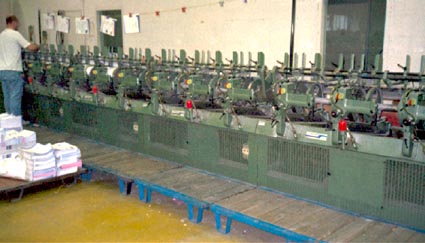
A binder is a machine which brings together printed and folded sections together and puts glue on the binding side -- it also puts a cover on in the case of soft cover books, an additional machine is required to put covers on hardback books. The older machines required employees to place sections in different "pockets" -- stacking them in a sort of vertical shoot -- usually a handful at a time. The new binder allowed an employee to load bundles of sections on a feeder tray into the pockets. The new machine was also lightning fast compared to the older machines -- I compared the difference to an A-6 Intruder and an F-22 Raptor. It required only one employee to man the feeder trays, as opposed to three or four on the pockets; however, more employees were needed at the other end to handle and box the finished product.

Later, when the business began to experience some trouble, I was moved out of the office to work in the shop. I worked on both the older machines as well as the new one, as well on folders and bundlers. Some new printing machines, called web presses, could fold the sections as they came off the machine, so many jobs came from the printer already folded.  But other jobs, printed on older presses, came as flat sheets; these were first folded and then bundled.

On the bundler, I opened and closed a vice via compressed air; I opened, placed a board (usually cardboard) on the right side and then started gathering and placing folded sections by the handful and I was required to continually open and close the vice.  When I had a certain amount of sections, I placed another board on the left side, closed the vice and tied a string around the bundle to hold it together.

I really did not like this machine as I figured it was only a matter of time before I got my hand caught -- I had to have my left hand on the last section I just put in and pull it out almost at the last second.  I was right as on my last bundle my hand was caught, it hurt like you wouldn't believe, but fortunately nothing was broken.  That would turn out to be my last day at the bindery, but I'm getting ahead of the story.


The bundles are then moved to a binder where the string or plastic bind -- if it came from the printer -- is removed. On the older machines a employee would be responsible for two or three pockets. I would take a handful of one section and put it n the first pocket, then of the second for the second pocket, then the third, and repeat. You had to keep track and not put the wrong section in the wrong bundle, but if you did you could hit a stop button and stop the machine. On the hot new binder, as noted, I put the bundles in the feeder trays before removing the boards and band.  Again, I would start with the first section of feeder and work my way through to the last, then repeat.


After a few years of doing billing and other clerical functions, I was tasked with doing the data entry for a new database of job estimates and when I completed that, I was trained to do estimates.  The printer would fax over a sheet with specifications for a book and I would return an estimate based on a price list.

A book has a binding side, the spine, and three sides that are the edges of the pages. If you hold a book so that you can see the top or bottom edge -- this sometimes can work with the edge opposite of the binding side -- you should be able to see that the pages are divided into sections, this is probably easier to see on a hardback book. In addition to paper type, book size and cover type there was also the number and type of sections that would determine the price per 500, 1000, 2000 or more. Sections came primarily in 32s, 16s and 8s (32 pages per section, etc.) and rarely in 48s, 4s or 2s (48s came from web presses sometimes).

In late 1998 or early 1999, we learned that our largest customer was up for sale.  We were concerned that a new buyer might put in his own binding and finishing equipment and would no longer need us. This brings us to how a family business started in the 1940s failed in the first decade of the 21st century.

In 1984, a paper-based time management system called the Franklin Planner was introduced. This planner would have a significant impact on my family's business, not as a tool used for management, but for other reasons. The Franklin Planner was designed and produced by a company that at some point became known as Franklin Quest. At some point in the mid-1990s, Franklin, in an effort to control its paper supplies purchased a company called Publishers Press.


Publishers Press, founded around the same time as Mountain States Bindery, occupied a building connected to the bindery by a common loading dock, and, as the biggest printer in the intermountain area, was our biggest customer. A publishing company called Bookcraft occupied a connecting building between Publishers and the bindery. Not long after Franklin bought Publishers Press, Bookcraft built a new building down the street and moved, and TriCox, a limited partnership of my grandfather, uncle and father, which owned the bindery, bought the Bookcraft building. At first we tried to lease the building but were unsuccessful. Eventually we used the building as additional storage space.

Getting back to Franklin's purchase of Publishers Press, the planner company divided printing company into two divisions, the planner division and the commercial division. Franklin, not surprisingly, was a little bit more concerned with the planner division and the commercial division experienced some neglect.

In 1997, Franklin acquired the Covey Leadership Center, formed in 1985 by The Seven Habits of Highly Effective People (1989) author Stephen R. Covey, and Franklin Quest became Franklin Covey. Just a couple of years after the merger, Franklin decided to sell the commercial division of Publishers Press. At Mountain States Bindery, we did not view this as good news.

The thing we most feared was that the new owner of the commercial division would buy his own binding and finishing equipment, thus causing us to lose most or all of the business of our biggest customer. There were a good number of smaller printers in the Salt Lake Valley and intermountain west, but collectively they could not match the output of Publishers Press.

We had several meetings about what to do and decided to make an offer to buy the commercial division. We were outbid by at least two other buyers, so it was not looking good for us. Then a reprieve, the sale to the top bidder fell through and there was a second round of bidding. Alas, we came up short a second time, and once again it looked like our goose was cooked. But, then, another unlikely reprieve as the second buyer was unable to close the deal. On our third chance the opportunity to buy the commercial division of Publishers Press fell to us, if only by default.

Now we had more meetings, because the more we looked at the books for the commercial division, we saw things we didn't like. Perhaps the other two buyers had backed out because they decided the commercial division was too much of a risk. Franklin's neglect of the commercial division had been worse than first thought. To save Publishers Press would require a heroic effort, with little margin for error. We almost balked at the prospect, but again the possibility of another buyer putting in his own binding equipment was unpalatable.

I can't speak for anyone else, I can tell you only what I was thinking. I wanted us to buy Publishers Press because I thought it would give me greater opportunities to advance in the family business. I was, at the time, the youngest of the third generation working for the family business -- my father was the youngest of my grandfather's two sons -- and I didn't have a college degree.

I was now making ten dollars an hour, which even in 2000 did not seem to be enough to raise a family on, even in a state with a comparatively low cost of living. I really thought buying Publishers Press -- the commercial division -- would be the best thing for me.  I prayed for it to happen. If they had asked me, I would have put my home up, I believed in it that strongly.

Our purchase of the commercial division of Publishers Press went through during the first half of 2000. It was a leveraged buyout, meaning the loan was borrowed against the assets of the commercial division. Because the bindery was smaller than the printer, we could not have done it any other way. It was actually the limited partnership of my grandfather, uncle and father, that purchased the commercial division and Mountain States Bindery and Publishers Press remained separate entities.

In the summer of 2000, I moved over to the accounts payable department of Publishers Press to handle supplier invoices. I kept the invoices filed and entered them in the computer system. As a small company, the bindery could not compete on price, so we competed on quality, and had a reputation for quality, not just across the United States, but in certain places around the world. In a similar fashion, as an employee, I competed on accuracy rather than speed. We had a saying at the bindery, "Be safe, be accurate, be fast, and when you've mastered those three, be even faster."

Everything seemed to start well as we took over the printing company, and the rush season was very good for us.  But then someone made a mistake. I only heard a rumor that someone in the printing shop made a million dollar mistake. Whatever happened it led to the banning of radios in the shop and in the office. In 2001 there were signs of an economic slow down, and then some fanatics drove some airplanes into some buildings. Whether we could have made it through after the big mistake, I don't know, but after 9/11 we were finished. We let the owners of our loan know that we were unable to make the payments and the process of foreclosure began.

In December 2001, I was moved into the bindery shop. While the lenders were to take possession of the printing company's assets, that apparently did not include the negatives of past printing jobs. These negatives were as big as the printed sheets that came off the presses -- before being folded -- and were kept in boxes about the same size.  Because of their size, shape and weight, they were a pain to move, and I moved a lot of them from storage in the Publishers Press building to the Bookcraft building. As we would no longer have a printing company, I doubt we ever got any value out of those negatives.

I also moved boxes and boxes of books that had been printed during the recent history of Publishers Press -- I managed to keep several World War II rated books for myself.  Most of these books had also been bound by Mountain States Bindery.

Sometime in January or February of 2002, Publishers Press closed its doors for the last time.  The lender took possession of the building, the machines and paper. There were quite a few people working for Mountain States Bindery who began looking for new jobs -- and I was one of them.

Without Publishers Press, it was doubtful that we could find enough work to keep Mountain States Bindery alive. The family business was dying, and the worst place to witness this long drawn out expiration, in my opinion, was in the shop. Things usually slow down after the beginning of the new year, but this winter was even slower.  There were days when the only work we had was to clean.

Working in the shop was a valuable experience, but I hated almost every minute of it. When I got my hand caught in the bundler, as I mentioned above, I reached the breaking point. I walked off the shop floor and never returned.

Even after my departure, life at the bindery went on. The end was dragged out over two, possibly even three years, as we sold off machines to keep the business alive. Business would have been hard enough without our biggest customer -- had another buyer succeeded in closing their purchase and had put in binding equipment -- but when we bought Publishers Press, all the smaller printers sent their business to the one or two small binders that existed. When Publishers Press failed, the smaller printers did not send much, if any business our way. So it was only a matter of time before Mountain States Bindery would have to close. There were rare occasions where I had reason to visit the bindery, and the saddest day was when I learned we had sold that hot, new, state of the art binder.

There were many people who told my uncle and father that they should just declare bankruptcy and walk away. But they had employees who had worked for them for years, who had been loyal. For the sake of those employees they held on as long as they could. But as you sell off all your machines, you decrease your production capacity, which makes it harder to pay the bills.

The death of the bindery was inevitable. When the end came, my cousins tried to make a go of it on their own with the last of our machines and equipment, but that quickly went nowhere.  A few years after the business closed, we sold the buildings that we still owned.  I go by those buildings at least once a year because the accounting firm that does my taxes is right across the street.  The new owners of the building changed the facade so that it looks nothing like it did when I worked there.

Sunday, July 7, 2019

Jerusalem 1999: Into the City


Back in April I began posting about my trip to Israel in April of 1999. I was in such a hurry to write about the first few days in country and left off as my tour group returned to Jerusalem from visiting the Dead Sea area, the Sea of Galilee area, and the Mediterranean Sea coast. The rest of the trip was spent largely in the greater Jerusalem area and, after a two month break I will continue my posts about the trip.

The Hyatt Regency Hotel in Jerusalem is of a rather unique design. Sitting on the side of Mount Scopus, northeast of the Old City, most of the floors are below the main floor, somewhat in the fashion of steps. There are other buildings among the seven hills that make up greater Jerusalem that are similar in architecture.

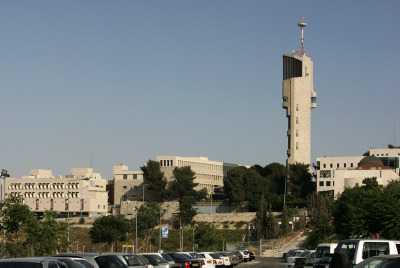
East of the hotel on top of Mount Scopus is the Hebrew University. On campus is a tower that almost defies description. It rises with four yellow-white sides, but it is the top that is so strange, black on three bigger sides. 


A little to the south of the university is the Brigham Young University Jerusalem Center. BYU students come here for a semester to study and learn about the Holy Land. The center was designed by the same architects as the Hyatt Regency and is of a similar step design in the side of the hill.

Further south is the Mount of Olives where several churches mark traditional sites of the Garden of Gethsemane. Across from these churches is the Temple Mount in the Old City. Today the Dome of the Rock and the Al Aqsa Mosque occupy the area.

On the morning of Friday, April 16, 1999, our tour bus took us to the western wall of the Old City and the Jaffa Gate. It is here that we entered the Old City for the first time. We walked along narrow streets filled with merchant shops -- the shops were closed since it was so early on a Friday.

Often considered the busiest gate in Jerusalem, the Jaffa Gate was built by Sultan Suleiman the Magnificent in the 1500s. In 1898, the German Kaiser, Wilhelm II, could not get his horses, wagons, and decorated coaches through the gate. It was traditional with most gates to have a sharp left turn as a way to slow down intruders in the case of an enemy attack. The Kaiser solved his problem by tearing an opening in the wall next to the gate.

The gate was restored by Israel after 1967. It still contains the typical oil chutes and loopholes used to defend the city during the Turkish occupation. Loopholes are slits in the very thick wall that broaden out toward the inside so that a soldier has enough maneuvering room to shoot out.

The Old City is divided into five sections; the Christian, Armenian and Jewish Quarters; the Moselm Section; and the Temple Mount. In the Christian Quarter is the Church of the Holy Sepulcher which marks the oldest traditional site of the crucifixion and burial of Jesus Christ. A newer site, discovered in the last 200 years, is the Garden Tomb just up from the North Wall and the Damascus Gate (In the interest of full disclosure, I am more partial to the Garden Tomb than the Church of the Holy Sepulcher as the burial site of Jesus).


First built some 300 years after the death of Jesus, control of the Church of the Holy Sepulcher is still argued by the following Christian denominations: Armenian, Catholic, Coptic, Greek Orthodox, and Syrian Orthodox. Relative peace between the groups is achieved by each church being allowed a turn at using some of the religious relics and places within the church, such as the Place of the Cross, the Rock of Unction, and the Sepulcher itself. The priests bring their own carpets, wall hangings, and lamps, as well as different colors and styles of vestments for worship. As soon as the shift ends they remove these things and their temporary ownership over.

In 1927 a major earthquake hit Palestine and severely damaged the church. The repair work was held up becuase of the conflicts of ownership claims. As soon as one group started repairs another group would object and assert their ownership. There was always someone to object as repairs could imply possession, and therefore, ownership. After 1967 the Jews and Arabs both stepped in to make or oversee repairs as neutral parties.

The Church of the Holy Sepulcher is actually several buildings built, and pinched together, over centuries of construction. The center of three little archway chapels is built over the place where it is believed Jesus Christ was crucified, another chapel is for the repentant prisoner crucified at the same time, and these two are beautifully decorated. A third, undecorated chapel, represents the the unrepentant prisoner on the third cross.

Close by and at the foot of the "rock" of crucifixion is the Rock of Unction, where tradition says the body was prepared and anointed for burial. As we stand here we see worshipers kneeling before the Rock of Unction, kissing it and praying.

To our left under a large dome is the Sepulcher itself. It is actually the fourth one built on this spot. We do not go inside the Sepulcher, but we are told that there are two chambers, a weeping or mourning chamber and the burial room. In the second room is a slab of marble, shown as the final resting place of Jesus.

As noted, there continue to be disagreement over ownership of the relics and places in the church. Currently the keys to the Sepulcher are in the hands of a Moslem and a quiet coexistence has been reached among the different denominations in the late 20th and early 21st centuries. However, in the nearby alcove for the Tomb of Joseph of Arimathea a standoff between the Armenians and Syrians is quite evident as the room is in serious disrepair.

As we leave the Church of the Holy Sepulcher behind and enter the Armenian Quarter to the south, many of the shops are beginning to open. We are on a very thin street, it seems like more of a hallway under the overhanging roofs above. Each shop is more like a little hole in the wall. After a meat carving demonstration by an Armenian butcher we move on to the Jewish Quarter to the east.

From 1948 to 1967 the Jewish Quarter was without any Jewish residents. The area was besieged in the 1948 War of Independence and every Synagogue was destroyed. After the eventual surrender of the Jews the Quarter became a slum. But in 1966 King Hussein of Jordan ordered the Arab squatters out of the area. Then came the Six Day War of 1967 when the Jewish Quarter was liberated by the Israeli Defense Forces. What they found were ruins and hovels. Since 1967 the Quarter has been tastefully rebuilt and excavations begun of ruins dating back as much as 2,700 years.

One such excavation is of the Burnt House which belonged to a Kathros family. The Kathros name is known in Jewish writings as one of the corrupt priestly families of the first century. When the excavation was completed the Wohl Architectural Museum was built around it.

Nearby this was an excavation of a wall that may have existed during the reign of King David. As we exit the Jewish Quarter the courtyard of the Western or "Wailing" Wall opens before us. Already their are Jews gathering to pray and worship at the wall. But we turn right, pass through a security checkpoint, and exit the Old City by the Dung Gate, so named because it is likely that the city's refuse was channeled through the gate.

From here our bus took us over to Yad Vashem, the Holocaust Museum, where we spent a mere hour and a half. I would have loved to have had more time.

Next on the agenda was a park where we each planted a tree. In 1999 there were two hundred million trees in Israel and the government was encouraging the planting of even more to replenish the land. Any group that plants a certain number of trees will have their name on a plaque at the site of their planting.

The Ensign Foundation is one group that has committed to a certain number of trees, and it was on behalf of that foundation that our tour group planted trees in Isreal. We planted  four on our own, one for my mother, one for my wife, one for me, and one more that my wife and I did together.

After the planting, we had a picnic lunch with Isreali street food, a deep pocket of bread stuffed with lamb, lettuce, sauce, and even fries. I loved it. I thought I had heard them referred to as falafels, but I have since learned that falafels are something completely different. I have visited a few restaurants in the Salt Lake area since that trip, but have have been able to find anything like what we had in that park.


After lunch we went to the Model City of Jerusalem. This is an accurate miniature of the Jerusalem of 2,000 years ago. It was built as a memorial by a father to the son he lost in the 1948 War of Independence. Great effort has been made to re-create the physical features as they were in the days of Herod the Great and the model is constantly being updated as new archaeological discoveries are made in Jerusalem.

From there it was on to Bethlehem. Like many urban areas, the cities here run together, and though Bethlehem is five miles from the Old City, it seems as if we have merely crossed into another part of town. Our destination is Nativity Square, a large open space with the Church of Nativity to the east and a mosque to the west. A mosque has been built near almost every Christian church in Israel.


The traditionally accepted birthplace of Jesus is in a Grotto located underneath the Church of Nativity where a gold star now adorns the red stained floor where it is believed Jesus was born. As with the Church of the Holy Sepulcher, there is a dispute over ownership of the Nativity Church, this time by just three denominations -- the Armenian, Catholic, and Greek Orthodox. Here, too, the churches rotate in their use of the grotto, bringing in their own decorative carpets, curtains and other accouterments.

In 1989 an Australian priest of the Armenian church was sent to direct the Armenian Bethlehem facility. He immediately made friends with the Catholic and Greek Orthodox priests and the centuries old conflict over two chapels was resolved.

As we were on our way back to the bus we were surrounded by Arabs. We are practically mobbed!, but fortunately they were only trying to get us to buy their merchandise. Outside of many historical and tourist spots there are Arabs selling such things as postcard books of the site you have just visited (especially nice for buildings you are not allowed to take photos in), camera film, pictures, bags, wood carvings, jewelry, etc. But these guys at Nativity Square were the most aggressive that I experienced.

After this our bus took us to a shepherds field. We were directly north of Nativity square on the other side of a ravine. Here we read the the book of Ruth, the Christmas story in Luke, and visited with Arab children. We also sang "Near, near at hand on Judea's hills, shepherds of old heard the joyous trills. . . ."

Wednesday, May 1, 2019

Israel 1999: Down to the Coast


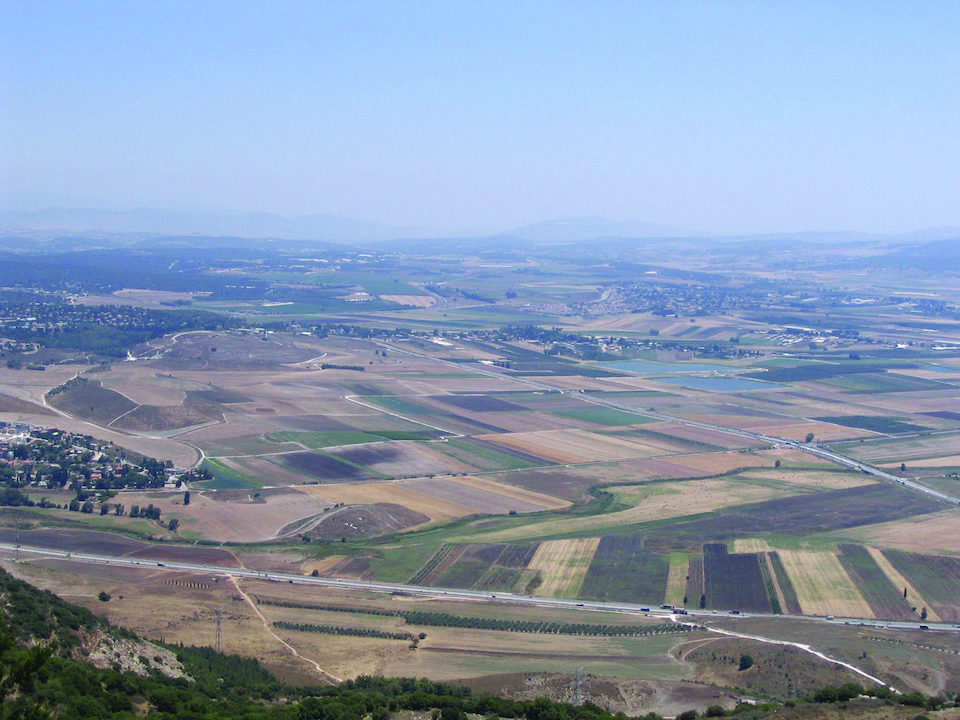
Our first stop on the Thursday, April 15, is on a hill in Nazareth overlooking the Jezreel Valley.

Jewish settlers first began arriving in the Jezreel Valley in the 1920s. Like those later in the Hula Valley, they found nothing but malaria-infested swamps. Again, just like those in the Hula Valley, they turned to and converted the Jezreel Valley into the breadbasket of Israel. Commanding this valley is Mount Tabor, believed by some to be the Mount of Transfiguration (see Matthew 17:1-9).

Anciently the largest tel, or "hill," in the Jezreel Valley is Megiddo. Another Hebrew word for hill is har and Mishnaic Hebrew scholars have called the place "Har Megiddon." Later, of course, it became known as Armageddon. It is the connecting point of the Crossroads of the East, and is known by Christians as a place specified for the Battle of Armageddon in the last days.


Behind us is the City of Nazareth, the childhood home of Jesus Christ. Today it is a busy city of Arabs and Jews, and the Arab population makes it one of the largest Arab cities in Israel. It lies at 1,200 feet above sea level halfway between the Mediterranean and the Sea of Galilee. In April of 1999 there was a minor disturbance here between Moslems and Christians over the location of a proposed Christian church.

Down the road is the Jumping Cathedral marking the hill wherefrom Nazerene's attempted to throw Jesus. This episode followed the Savior's reading in the synagogue:

“The Spirit of the Lord is upon Me,
Because He has anointed Me
To preach the gospel to the poor;
He has sent Me to heal the brokenhearted,
To proclaim liberty to the captives
And recovery of sight to the blind,
To set at liberty those who are oppressed;
To proclaim the acceptable year of the Lord.”

“Today this Scripture is fulfilled in your hearing.”

Those present took him to the hill, but he passed through the midst of them and went upon his way (See Luke 4).

Back on the bus we see an increase in industry as we near Haifa on the Mediterranean coast. Oil refineries, steel mills, and manufactures thrive in Haifa where one of the finest technical universities in the world is found. The city's "Technion" or Institute of Technology is the high tech center of the Middle East.

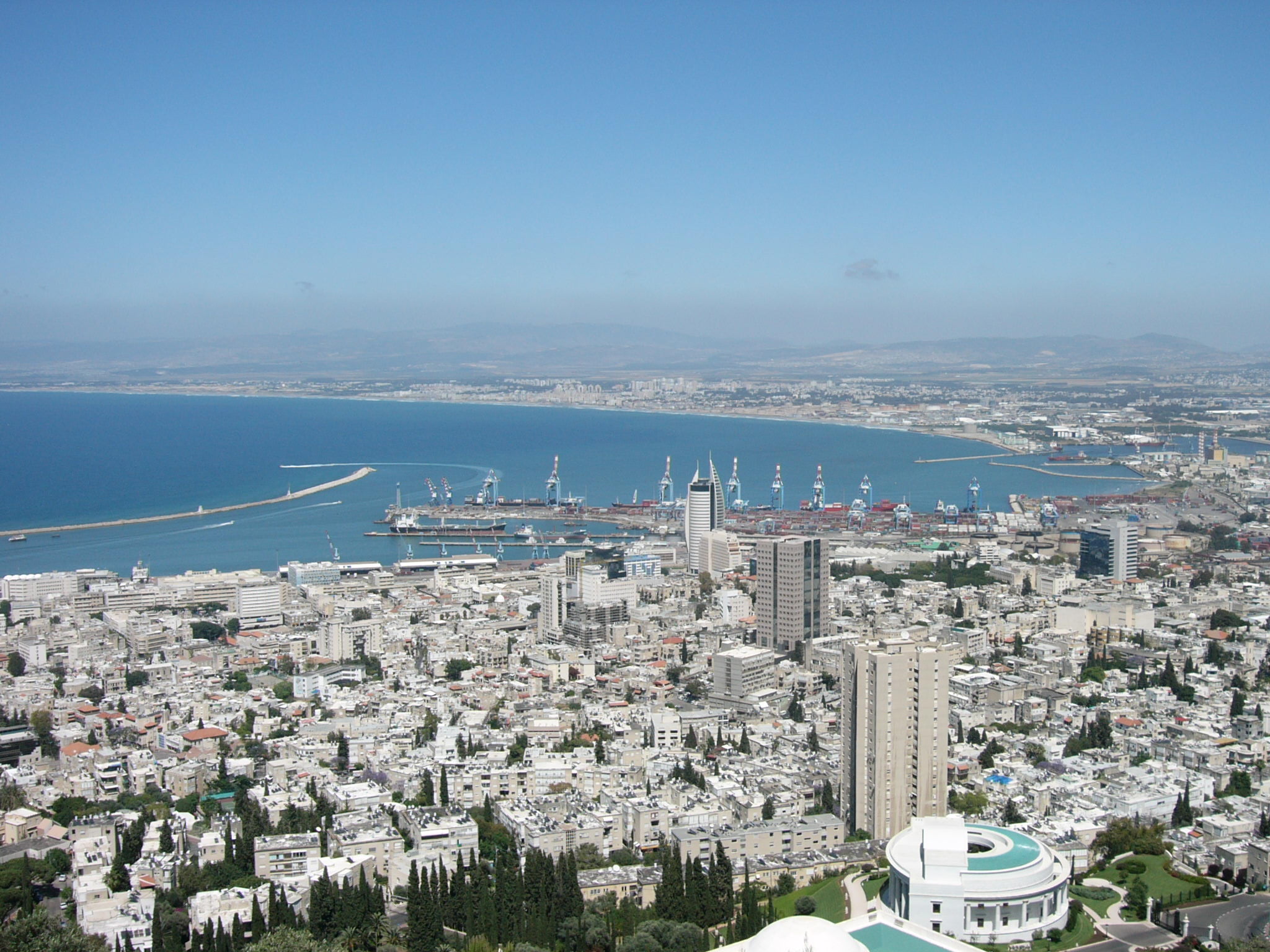
Haifa reminded me of San Francisco -- which I visited in January 1990 -- as it rises and falls on the heights of Mount Carmel. We stop on a hill overlooking the harbor which was built by the British in the 1930s. A breakwater was put in to accommodate the modern ships and tankers that visit this busy seaport.

As a US Navy buff I am quick to spot an Aegis destroyer at anchor in the harbor. Our guide has shared so much with us, and I feel compelled to return the favor by telling him about the Arleigh Burke class guided missile destroyer. As I explain that it is designed to shoot down anti-ship missiles, he responds that Israel could use something like that to combat the rockets launched from southern Lebanon. Israel has since fielded the Iron Dome defense system against rockets fired from Lebanon.

From here we can also see the world headquarters of the Baha'i. With close to 5 million members worldwide this religion believes that all men are brothers and that they should speak the same language. They also believe that their religion will rule and judge all people at the last days, before the "end of the world." We can also see their new justice center under construction. After suffering severe persecution in Persia (Iran) in the 1800s the Baha'i moved their headquarters to Mount Carmel.

Back on the bus we start south along the coast of the Med.

Halfway down the coast to Tel Aviv is the ancient capital of Palestine, Caesarea. The Romans provided the capital with fresh water by building an aqueduct the 13 miles south from Haifa. Remains of this aqueduct are found a few miles north of Caesarea. We stop here briefly for photos and a quick explanation, then it is a quick hop over the the ruins of the ancient capital.


Caesarea was a magnificent city with a breakwater harbor that was constructed by lowering wooden forms with stone weights and then filling them with concrete. The city also contained a theater, amphitheater, and sports hippodrome. Unfortunately the city became a center of Jewish revolt in 63 A.D. (or C.E. for Common Era) and it was destroyed by the Romans. Rebuilt it became a center of Jewish and Christian schools until it was again destroyed by Moselms in the seventh century. When the Crusaders came they built a fortress here, complete with a moat.

Excavations are currently ongoing in Caesarea. We see the Crusader fort to the right as we drive in. To our left is the reconstructed amphitheater. After reading about the trial of Paul before King Agrippa here in Caesarea we are allowed to search an area for ancient glass. Some of the glass found here dates back at least two thousand years when the Romans had a technique of mixing silver in the molten glass.


After lunch we are on our way to Tel Aviv and Jaffa.

Haifa is the third largest city in Israel and Tel Aviv, or "Sring Hill" -- the couple from Springville, Utah, got a real kick out of that -- was the largest until recently when it was surpassed by Jerusalem with a few thousand more people. Tel Aviv is an international city of people from all over the world and is considered the "Miami Beach of the Med." If New York City in the Big Apple, Tel Aviv is the Big Orange.

Just south of Tel Aviv is the ancient port of Jaffa, or Joppa as it is sometimes called. It is, perhaps, the oldest seaport in the world.

It was from here that Jonah tried to avoid his mission to Ninevah. Jonah's ship encountered a major storm and the crew, determining Jonah to be the cause, threw him overboard. As the story goes Jonah was swallowed by a whale only to be spit out after three days. But according to Jacques Cousteau, whales are rarely found in the Med. There does exist, however, a grouper fish that, according to experts, can grow large enough to swallow a man. There are modern tales suggesting such occurrences.

There is also a connection to Napoleon here in Jaffa. A French Army laid siege and then captured the port in March of 1799. Here and there we see painted statues of the little emperor pointing the way to a museum.


Jaffa is also the site where Peter had a vision. He was staying at Simon the Tanner's house when he had a dream in which an angel commanded him to eat non-kosher food that was wrapped in a talith. Not long after this a man named Cornelius shows up saying that a vision had directed him to Peter. At last the meaning of Peter's dream is revealed, he is now commanded to teach the gospel to gentiles (see Acts chapter 10). Today, St. Peter's Cathedral commemorates the spot.

Another day is done and we return to the Hyatt Regency in Jerusalem. Tonight some of us in the tour group went to the Jerusalem YMCA for a show featuring Jewish folk dancing and singing. It was quite a show, even though I had trouble staying awake as I was still adjusting to the time change. In my defense, the show did not start until 9 pm.

Sunday, April 28, 2019

Israel 1999: Galilee


We awoke on the morning of April 14, 1999, to a rain storm in Galilee. It was the only rain I saw in all of my time in Israel.

The storm has stopped by the time we reach our first destination of the day, the Dan Nature Preserve. It was this area in which the tribe of Dan was given to live, and now a beautiful forest has been set aside. It is here that the River Jordan runs wild. The waters of this and other brooks and streams come out of the ruins of the tribe of Dan, combine with the runoff from Mount Hermon, and flow into the Sea of Galilee.

The Hebrew word for "going down" is yored, and there are some who believe that the origin of the name Jordan is the term or expression yored-Dan. Though Joshua led the children of Israel across the River Jordan before the tribe of Dan settled in this area, perhaps the account of the crossing, written later, simply used the then-known word "Jordan." As we walk along in this forest I am struck that this is the last thing I would have expected to find in Israel.

Back on the bus we are now traveling north through the Hula Valley. When Jewish settlers arrived here in the 1940s and 50s they found nothing but stinking swamps. Undeterred, the settlers set to draining the swamps and making the land fruitful. They succeeded and several settlements dot the fertile countryside.

Metulla is the northernmost city in Israel. It is like an alpine ski village and there are two ski lifts on Mount Hermon, which rises to almost 10,000 feet. Nearby is Kibbutz Kfar Giladi, which was founded in 1916. It is a typical agricultural collective settlement, but it also has a popular hotel with tourist facilities. In Hebrew the word kfar means "small town" or "village," and a gentlemen named Gilad was one of the town's founders. Next to the Kibbutz is the city of Kiryat Shemona. Kiryat means "city" in Hebrew and Shemona means "eight." The City of Eight was named for eight men who defended this area during the 1948 War of Independence. Their Arab attackers were unaware that the eight men were mortally wounded. The eight fought so fiercely that the attackers fell back and abandoned the attack.

When Israel proclaimed statehood in 1948 many Arabs from northern Israel settled in southern Lebanon. Recently many thousands of these Moslems and Christians have come back across Israel's "Good Fence" for medical aid as well as to shop for basic necessities. Up to the year 2000 there were hundreds of Lebanese that regularly worked in Israel.

At the foot of Mount Hermon, by a huge rock escarpment, new excavations are revealing the once prominent Roman City of Caeserea Philippi. It was here that Jesus Christ asked of Peter and the apostles "Whom do men say that I the Son of man am?" (see Matthew 16:13-19)

We are now entering the Golan Heights. Here and on Mount Hermon there are several villages of Druze, a people claiming to be descendants of Jethro, the father-in-law of Moses. The Druze are an industrious, secretive, and colorful people. They are also an integral part of modern Israel, serving in the government and the military. Half of the Druze people live across the border in Syria. Israel has made repeated efforts to open the border for family reunification. This has slowly happened, but underneath the radar. Publicly the Druze proclaim Syria as their mentors, while hundreds of Druze have crossed back and forth across the border. There are annual protests that have prompted our guide to coin the term "Druze Ruse." All of this will probably continue as long as the media does not publicize the crossings.

During the first two decades of the modern state of Israel it became clear that the Syrians were using the Golan Heights as nothing but a gun platform for firing down on Israeli settlements in the Hula Valley and around the Sea of Galilee. The Six-Day War of 1967 was a preemptive counteroffensive launched by Israel, and during this conflict the Golan Heights were taken from Syria.

Since the war heights have become a peaceful place -- except for a few days in 1973. Israelis have cleared this rocky land and discovered great farming soil and new water sources. A unique combination of rich volcanic soil and modern farming techniques have produced outstanding agricultural yields, including award-winning grape and wine production.

As we drive across the Golan Heights our guide tells us of the surprise offensive of Syria in the Yom Kipur War of October 1973. As a military history buff I am enthralled by the story. Out of the windows we see beautiful, fertile fields, a few military installations, and tanks or tank turrets that have been turned into memorials.


We now descend back to the shores of Galilee and the ruins of Capernum.

In recent years the ruins of Capernaum have been uncovered by excavations. This toll city for Rome may have had ten thousand Jewish and Roman inhabitants. Carpernaum was also the place where Jesus Christ performed most of his miracles. Among them:

Peter finding a coin in the mouth of a fish big enough to pay the toll (see Matthew 17:25-27).

A palsied man being lowered on his bed through a roof and healed by Jesus (Mark 2:3-12).

The healing of a man with a withered hand (Matthew 12:10,12 & 13).

The healing of Peter's mother-in-law (Matthew 8:14-15).

After failing to catch fish all of one night Peter was instructed by Jesus to lower his nets, he did so and caught an unbelievable amount of fish (Luke 5:3-6, 9-11).

The healing of the Roman Centurion's servant from a distance (Luke 7:1-10).

A woman being healed by the simple act of touching Jesus' garment (Mark 5:21-34).

At the time Jesus was on his way to heal the daughter of the leader of the synagogue. Because he was delayed he arrived to find the child dead. Jesus sent all the mourners away and then entered the room where the child lay. He then took her hand and said "Talitha cumi." The endearing term Talitha may have been his way of saying "my little lamb," or "curly locks" and cumi means "get up" in Hebrew. The child arose and walked (Mark 5:40-42).

Returning to the story of the Centurian, this Roman had a great love for the Jewish people, so much so that he built them a synagogue in Capernaum. It is in the ruins of this meeting house that we sit and read about these many miracles.


Our guide also introduces us to a garment of wool called a Talith. It is a shawl-like garment worn by modern Jews, and the name seems to come from the Hebrew word meaning "lamb," taleh. The hem or the strings of the talith are customarily touched during Jewish religious services. The four sets of strings are knotted for a sum total of 613 strings and knots. There were 613 laws and covenants -- including the Ten Commandments -- given to Moses. Modern Jews touch the strings and knots to remind and commit themselves to keeping the laws.

Perhaps the woman who touched Jesus' garment and was healed, touched, or was trying to touch, his talith.

It is a short drive from Capernaum to the traditional site of the Mount of the Beattitudes, or the place where Jesus taught the Sermon on the Mount. This is on the northern shore of the Sea of Galilee and it is a remarkably peaceful place. Even ancient travelers have written of the peaceful feeling of this Mount. Today a church designed by Italian architect Antonio Barlucci, sits on the hill overlooking the sea.

After a brief walk-through of the church we find a spot on the hill and read through the Sermon on the Mount. For me this is one of the main highlights of the trip. "What a place of sweet spirit," as many a traveler has written. Add to it the beautiful scenery, and it is an experience to be unmatched by any other. There are two places in Israel I most yearn to visit again, and this hill is one of them.

Down to Tiberias we go, enjoying more of the beauty of the land around the Sea of Galilee. We stop for lunch and are each served St. Peter's fish. In reference to the story where Peter found a coin in the mouth of a fish, one person at each table finds a coin in the mouth of their fish -- at my table it is my wife who finds the coin.

After lunch we enjoy a brief boat ride on the Sea of Galilee. The sea is 700 feet below sea with heights surrounding, including Mount Hermon which rises almost 10,000 feet. Because of this it is quite common for sudden storms to arise on the lake. We are lucky today as there are no storms, just a beautiful sunny day. Our short boat ride takes us to another part of Tiberias. At this place a Christian group has a store and theater where they present a slide show called "The Galilee Experience." The slide show covers 4,000 years of history.

After this we end the day of touring a little early, so that many in the group can return to the spa hotel for many of the massage therapies provided. My wife really enjoyed the aromatherapy she received.

The next day will see us on the Mediterranean coast before returning to Jerusalem.