Sunday, November 20, 2016
Replace Bashing with Charity
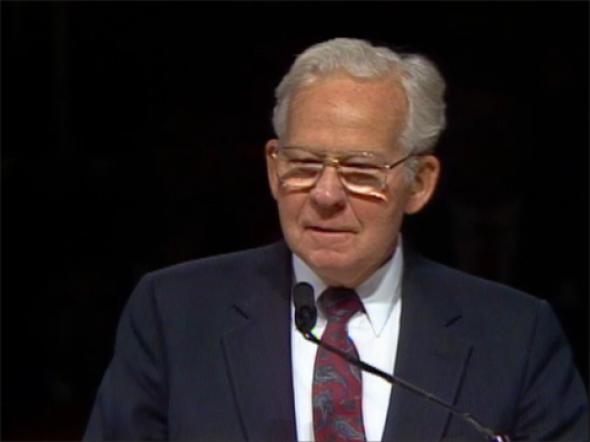
I saw this morning a story criticizing a public figure for something he once said, I was reminded of a talk given by Marvin J. Ashton a number of years ago. Basically, if we look long enough and hard enough, we can find any statement or action by someone that we can find fault with, we can do this because everybody is human.
Because it is so easy to find fault, we may think that we know everything we need to know about an individual as we judge them harshly. The reality, however, is that we are like the character Sergeant Schultz from the television comedy series Hogan's Heroes, "We know nothing, nothing."
We do not know what we do not know. We cannot see into the hearts and minds of those we criticize. Hidden from our view are the trials and heartaches others are dealing with. We do not know the private Gethsemanes people are experiencing.
King David once compared the tongue with a sharp sword (Psalms 57:4). Much later someone said that the pen was mightier than the sword. Many in the world today may yet identify with David, feeling themselves to be the victims of those who use their tongues (or their keyboards) as sharp swords. The misuse of our tongues seems to add intrigue and destruction as the media and private persons indulge in this pastime. In today's vernacular this activity is called bashing.
Bashing - to strike with a heavy crushing blow.
"This popular behavior is indulged in by far too many who bash a neighbor, a family member, a public servant, a community, a country, a church," said Elder Marvin J. Ashton during the April 1992 General Conference the of Church of Jesus Christ of Latter-day Saints. "Some think the only way to get even, to get advantage, or to win is to bash people. Often times character and reputation and almost always self-esteem are destroyed under the hammer of this vicious practice. How far adrift we have allowed ourselves to go from the simple proverb 'If you can't say something good about someone or something, don't say anything' to where we now are often involved in the bash business."
You don't have to be religious or a Christian to believe that kindness is better than meanness. Nonetheless, it is particularly striking to me when I see self proclaimed Christians participate in bashing. For "even though," said Elder Aston, "reports and rumors pertaining to misconduct and misbehavior are readily available and can make good ammunition for those who would injure, bash or damage, Jesus Christ reportedly declared that he who is without sin may cast the first stone. Ugly reports and conversations are always available to those who would promote the sordid and sensational. But none of us are yet perfect. We each have failings that aren't terribly difficult to detect -- especially if that is the aim. Through microscopic examination one can find in almost every life incidents or traits that can be destructive when they are magnified."
Christians are to be reminded that their Savior, reportedly the only perfect person ever to walk the earth, taught us through quiet example to say nothing or to be silent in stressful times in our lives rather than to spend time and energy bashing for whatever purpose.
"So what is the antidote," asked Elder Ashton, "for this bashing that hurts feelings, demeans others, destroys relationships, and harms self esteem? Bashing should be replaced with charity."
Joseph Smith said that "If we would secure and cultivate the love of others, we must love others, even our enemies as well as our friends. We should cease wrangling and contending with each other, and cultivate the principles of union and friendship. We need to be kinder with one another, more gentle and forgiving. We need to be slower to anger and quicker to help. We need to extend the hand of friendship and resist the hand of retribution. In short, we need to love one another with a pure love, with genuine charity and compassion and, if necessary, shared suffering."
While the word charity is often equated with visiting the sick or giving to those in need, it is much, much more than that. "Real charity is something you acquire and make part of yourself," said Elder Ashton. "When this virtue is implanted in your heart, you are never the same again. It makes the thought of bashing repulsive.
"The greatest charity," Elder Ashton continued, "comes when we are kind to each other, when we don't judge or categorize someone else, when we simply give each other the benefit of the doubt or remain quiet. Charity is accepting someone's differences, weaknesses, and shortcomings; having patience with someone who has let us down; or resisting the impulse to become offended when someone doesn't handle something the way we might have hoped. Charity is refusing to take advantage of another's weakness and being willing to forgive someone who has hurt us. Charity is expecting the best of each other, but being understanding and patient when it doesn't happen."
We all have weaknesses and challenges, and we don't need someone to point our failings out to us as we are probably already fully cognizant of where we are falling short. What we really need are family, friends, employers, associates, etc., "who support us, who have patience with us, who believe in us, and who believe we are trying to do the best we can, in spite of our weaknesses. What ever happened to giving each other the benefit of the doubt? What ever happened to hoping that another person would succeed or achieve? What ever happened to rooting for each other?"
Much of what Jesus Christ taught seems to center around the virtues of love, compassion, forgiveness, and long-suffering -- in other words, those qualities that enable us to deal with our fellow human beings more compassionately. Much of what Jesus taught centered around the way we treat each other. Yet many who profess to believe in Him are willing participants in the bashing so common today.
Instead of being bashers, we should be nurturers; people who build rather than destroy. We should have understanding and forgiving hearts, and look for the best in people. We should leave people better than we found them. We should be fair with our competitors, whether in business, athletics, politics, on the Internet, or elsewhere. We should not try to "win" by intimidation or by undermining someone's character. We should lend a hand to those who are frightened, lonely, or burdened.
"If we could look into each other’s hearts and understand the unique challenges each of us faces," Elder Ashton concluded, "I think we would treat each other much more gently, with more love, patience, tolerance, and care. . . . Let us open our arms to each other, accept each other for who we are, assume everyone is doing the best he or she can, and look for ways to help leave quiet messages of love and encouragement instead of being destructive with bashing."
“The fruit of righteousness is sown in peace of them that make peace.” (James 3:18.)
Source: Ashton, M. J. (1992). "The Tongue Can Be a Sharp Sword." Accessed January 23, 2013 at https://www.lds.org/general-conference/1992/04/the-tongue-can-be-a-sharp-sword?lang=eng
Monday, July 25, 2016
"The Fire of the Covenant"
Fear not I am with thee: oh be not dismayed
For I am thy God and will still give thee aid.
I'll strengthen the, help thee, and cause thee to stand
Upheld by my righteous omnipotent hand.
(How Firm A Foundation, Hymn 85)
By the summer of 1846, most of the Mormons had left Nauvoo, but in the fall some 700 still remained. These were the poor and destitute who did not have the resources to cross the plains. The enemies of the LDS Church became impatient and forced these poor souls out of Nauvoo. When word reached Brigham Young at Winter Quarters he called for rescue parties to go back to Nauvoo. The saints at Winter Quarters were not much better off than those who had been driven by mobs out of the City of Joseph.
In calling for rescue parties, Brigham Young reminded the saints of the Nauvoo Covenant, which they had made in the temple before leaving the city. Each had made a covenant to not leave anyone behind, even if they had to sacrifice their own goods to bring them along.
"Now is the time for our labor," said President Young on September 28, 1846. "Let the fire of the covenant, which you made in the house of the Lord, burn in your hearts like flame unquenchable! Rise up, brethren, take your teams and wagons and go straightaway to the Mississippi and bring a load of the poor back here where we can help them find shelter for the winter."
One of those present at Winter Quarters that day was James G. Willie who ten years later, in 1856, would lead the fourth company of handcarts across the plains to the Salt Lake Valley. A fifth company led by Edward Martin would follow. Both companies left late in the season and were caught in the snow in what is now the state of Wyoming. When word reached Salt Lake City of these two companies, Brigham Young would again issue a call for rescue parties.
"That is my religion," said the prophet on October 5, 1856. "That is the dictation of the Holy Ghost that I possess. It is to save the people! We must bring them in from the plains." After detailing the number of wagons, mule teams and drivers needed, he went on, "Let me make myself perfectly clear. I will tell you all that your faith, all your religion, and all your profession of religion will never save one soul of you in the celestial kingdom of God, not unless you carry out just such principles as I am now teaching you. Go and bring in those people now on the plains! Attend strictly to those things which we call temporal duties, otherwise your faith will be in vain. The preaching you have heard will be in vain to you, and you will sink to hell, unless you attend to the things we tell you."
Today we are called to different kinds of rescue missions. Young men and women are called to serve full time missions to preach the gospel and to gather in the tribes of Israel. The rest of us are called to be member missionaries, to share the gospel with our friends and to work with the full-time missionaries in finding for them people to teach. Additionally, we are called to stretch forth the hand of mercy and compassion to those in need, from the heartbroken in our own neighborhoods to the refugees of war on the other side of the world. Like the saints in Nauvoo, we too have made covenants, and the fire of those covenants can burn within us like an unquenchable flame.
For many gathering to Zion between 1846 and 1869, it was the fire of the covenant that sustained them as they crossed the plains. Pioneers crossing the Oregon, California and Mormon trails spoke about "seeing the elephant"; this phrase meant that somewhere along the trail the enormity of the task of crossing the overland trail was impressed upon them. Today we may feel that our callings to share the gospel and to serve others is an enormous one, and we may shrink from it. There may be days on a mission when an elder or a sister might feel that the fire of the covenant is not burning very brightly within them. The rest of us may have days like that as well.
A character in Gerald Lund's novel of the Willie and Martin handcart companies, Fire of the Covenant, felt that way after her company had been rescued only to find that they still had to walk the trail to get to the Valley. This led another character to ask, "Do you have even the slightest doubt about whether God lives, about whether His Son came to earth and lived and died so that we might live again?" The first character answered, "No, I have not the slightest doubt."
"Then why do you say that the fire of the covenant has gone out in you," asked the second character. "Don't you see? It is the fire that drives us. It is our faith in the Savior that sustains us. That is what give us the strength to go on, even now as we start this terrible day." Though rescued, this party was about to cross one of the most difficult parts of the trail known as Rocky Ridge. "And it is our faith in Jesus Christ and His sacrifice that allows us to say, 'And should we die before we reach Rock Creek this night, then happy day! All is well."
It is through faith in Jesus Christ that we may find the strength and courage we need on our most difficult days. The fire of the covenant may be burning brightly within us even when we are discouraged. So, "Gird up your loins; fresh courage take. Our God will never us forsake! And soon we'll have this tale to tell -- All is well! All is well!"
Wednesday, May 25, 2016
“The Son of Man Hath Descended Below Them All, Art Thou Greater Than He?”
My first area in the California San Jose Mission was in Palo Alto, and included at least part of the campus of Stanford University. We often went onto campus on our P-days to visit such places as the Rodin Sculpture Garden and the Memorial Church (which we called the "great and spacious building"). The Stanford Memorial Church is an impressive structure that has been called "the University's architectural crown jewel." Among the many architectural features of the church there are inscribed on the interior walls many inspirational quotes. On one particular P-day I noticed the following quote, and was so inspired that I wrote in down:
"There are but few on earth free from cares, none but carry burdens of sorrow, and if all were asked to make a package of their troubles, and throw this package on a common pile, and then were asked to go and choose a package which they were willing to bear, all would select their own package again. Your heartaches may be great, burdens heavy, but look about you, and with whom would you change?"
I have written before that the first four months of my mission were difficult, that it appeared that the Lord had something else on the agenda besides teaching and baptizing. At the time my mother wrote me several letters that were helpful. Among the thoughts she wrote were these:
“Know that the Lord will not permit you to have more problems than you can deal with. Be confident because of your faith in him. . . . Lean on the Lord. Trials can help you come closer to him.”
“I will have to inform you that trials (or ‘opposition in all things’) continue for life, so be prepared. Your attitude will get you through.”
“People are always moving around and doing new things. The Lord knows you and what’s in your heart and will do right by you.”
She also quoted Dr. Scott Peck from The Road Less Traveled: “Once we truly understand that life is difficult – once we truly understand it and accept it then life is no longer difficult. Because once it is accepted, the fact that life is so difficult no longer matters. Life is a series of problems.”
The Prophet Joseph Smith once said that “The things of God are of deep import and time and experience and careful and ponderous and solemn thoughts can only find them out.” He knew whereof he spoke because he had spent time and gained experience in Liberty Jail. There he received a revelation in which the Lord listed many awful things that could happen to him and that these things would give him experience and be for his good. Then He said, “The son of man hath descended below them all, art thou greater than he?”
Adversity is a fact of life, it is how we learn and grow so that we can become like our Heavenly Father if we submit ourselves to Him. Sometimes we face intense challenges that are of a relatively short duration, such as what happened on Omaha Beach on D-Day, the Sixth of June 1944. Other times we may face less intense challenges, but of a longer duration, such as the fighting in the hedgerows of Normandy after D-Day. Sometimes, with little rest we may go from our Omaha Beach and into the hedgerows.
Some trials may affect us our entire lives. On July 24, 1985, my mother collapsed at home due to a brain tumor; though she lived, the surgery to remove the tumor effectively cost her her short term memory. At the time she was very near the completion of her college degree. After recovering she went back to school only to experience great difficulty. She wrote me about one particular episode:
“I just learned something new that I think will really help me. My patriarchal blessing tells me over and over that I will influence people for good. I haven’t been too effective at home, my Relief Society teaching is likely at an end, etc. In my Spanish 4 and 5 class, however, they interviewed me and found I’d had a brain tumor. They thought that meant I’d had cancer. They think I’m a class heroine. When I checked out of Spanish 5 (I could see that I couldn’t go on and get my B.A. without the ability to memorize), they wrote cards and called to get me to come back. They saw me as someone who was persisting with life despite difficulties and I was a positive influence to them. Sometimes we don’t understand the Lord’s reasoning or his timetable and we become discouraged, but there is hope in the future. If you get discouraged, just remember your old mother got discouraged, too, before she saw answers.”
My mother did not get her degree even though she was just a few credits short of graduation. In addition to her fellow students, my mother helped me through the trials I experienced on my mission. I have referred to those two years as a university of life. I learned more in those two years than at any other time in my life. My mother helped me to learn some of those lessons.
Tuesday, May 3, 2016
The Signals We Send
Seventy-five years ago this month of May, the mighty German battleship Bismarck broke out in the Atlantic Ocean. His mission (the ship's captain insisted that his ship should be referred to in the masculine rather than the traditional feminine) was to find and sink Allied convoys. But this mission was quickly forgotten in the face of damage received during the Battle of the Denmark Strait; while Bismarck had sunk the most famous British warship, the battlecruiser Hood, she took a few hits from the battleship Prince of Wales which damaged a fuel-oil tank in his bow, and this led to a decision to make port in France.
The German battleship was shadowed by two British cruisers, Suffolk and Norfolk, as she raced east across the Atlantic toward the Bay of Biscay. The intent of the British ships was not to engage Bismarck in another battle, but to track him by radar until another force of British battleships could close in for another major battle. But at one point the German battleship circled around the British cruisers, breaking contact. Ironically, the German sailors might not have been aware that they had broken contact, for not long after they sent a long radio message to fleet commanders ashore, and this helped the British find Bismarck again.
While the British had lost radar contact, it is likely that Bismarck was still detecting the radar signals from a British ship. Radar, short for radio detection and ranging, transmits short radio pulses which are reflected when they hit an object like a ship or an airplane. Some of the reflected energy is then received by the ship that sent the pulse, and this allows a reading of range and bearing to be taken. The hitch is that the pulses have to be strong because only a fraction of the radiated energy would form an echo that the radar could detect.
Because the radar pulses must be rather strong, it is possible that those pulses were detected by receiving equipment aboard the German battleship, even though the echo was too weak to be caught by the British radar at the increased range following Bismarck's circle maneuver. The cruisers were almost 125 miles (200 km) astern of the battleship when the message was sent -- the British battleships were actually closer, so it is possible the radar pulses came from them instead of from Suffolk and Norfolk.
The long message was picked up by two British listening stations which allowed a search aircraft to find the German battleship. The sighting then led to an air attack by torpedo bombers launched from the aircraft carrier Ark Royal, and a one in a million torpedo hit disabled Bismarck's rudder, and this allowed the battleships King George V and Rodney to find and sink the German battleship.
A greater threat than German surface raiders, even one as powerful as Bismarck, were the u-boats which prowled the convoy routes across the Atlantic. The two weapons which helped defeat the U-boat peril were radar and high frequency direction finding (HF/DF, also known as "Huff Duff"). By using antennas at different locations, Huff Duff received a radio transmission at different angles and used the differences to determine a bearing to the transmitter. What made Huff Duff so successful during the war was the speed with which it could determine the bearing to a u-boat transmitting a radio message; this allowed allied warships to locate and attack the enemy submarine.
The battle of the laboratories continued during the Cold War, and the U.S. Navy spent a lot of effort on what it called "emissions control," or EMCON. The purpose of EMCON was to prevent the Soviets from homing in on the radar and radio transmissions of U.S. Navy ships. EMCON could be as simple as turning everything off, radar, radio and any other equipment that emitted an electronic signal. During World War II, the Germans developed a radar detector and such detection equipment became more sophisticated during the Cold War, to the point that it was no longer necessary to use radar to search for the enemy as you could track him through his electronic emissions -- assuming that he had not turned everything off.
Since the end of the Cold War, there has been another wave of technological progress with wireless communications. Rear Admiral William Leigher, USN, a veteran cryptologist who recently carried the title "director of warfare integration for information dominance," stated in a 2013 interview that the electronic emissions problem is significantly greater now than it was in the past.
“It’s not as simple as EMCON that I might have done in the mid-’80s or early 90s,” Leigher warned. For one, you can't just turn everything off because you need your sensors to detect incoming missiles and your jammers to disable them. In the future, suggested Leigher, instead of shutting systems down to avoid detection, a Navy ship might deliberately change the signals it emits to make the enemy think that it is something else -- during World War II, the allies tricked German u-boat commanders into turning their detectors off by suggesting that aircraft could home in on its signal.
Fascinating as all of this is, I'm sure there are many of you who are wondering just what it has to do with anything. As humans, with or without the aid of electronics, we are always emitting something. People see us and hear us, and we send signals through body language as well as through the things that we say -- or even the things that we don't say. Social media allows us to interact with people around the world, even people we don't know -- even people that we are not aware of. We might try a form of EMCON by avoiding people, on social media or in person, but that would leave us isolated and, in any case, probably wouldn't actually work. Even when we keep to ourselves we are sending out signals.
It would be more useful, then, to take a look at what we are emitting. Through our body language and our words we may signal happiness and friendship, generosity and other good things, or we may signal anger, suspicion, selfishness, immodesty, etc. We may signal other things via social media by what we choose to post, or what we choose to like or share.
In recent efforts by members of the LDS Church to share the gospel via social media, people have been using the hashtag "sharegoodness". We can share goodness, or we can share things that are less than good. We may even share goodness on the one hand, while also sharing some not so good things on the other, in which case we are sending mixed signals that may serve to confuse.
When Alma the Younger started his mission to the Zoramites, he took along with him Amulek, Zeezrom and two of his sons. One of these sons left his mission to chase after a harlot; Alma later said to this son, "Behold, O my son, how great iniquity ye brought upon the Zoramites; for when they saw your conduct they would not believe in my words" (Alma 39:11)
Alma went on to say, "And now the Spirit of the Lord doth say unto me: Command thy children to do good. lest they lead away the hearts of many people to destruction" (Alma 39:12).
People are watching us, whether we like it or not. If they see in us a good example, they may become interested in learning more about the church. If they see in us a bad example, they may be less likely to become interested.
We might think that we can hide behind the anonymity offered by social media, but we would likely be deluding ourselves. Some seek to hid their identity as they post certain thoughts, quotes or photos, while at the same time broadcasting that they are active LDS. Even if their identity is never discovered, these actions are mostly likely just as damaging.
We, of course, are human, and we will make mistakes -- and there are those who will deliberately seek to push our buttons in order to accuse us of hypocrisy -- but let us strive to be a good example, let us strive to share goodness. Let us be ever mindful of the signals we send when we post, like or share things on social media.
--
Sources:
Freeberg, S. J. (2013) "Navy Battles Cyber Threats: Thumb Drives, Wireless Hacking, & China." Breaking Defense. Accessed September 10, 2014 at: http://breakingdefense.com/2013/04/navy-cyber-threats-thumb-drives-wireless-hacking-china/
Zettering, N. & Tamelander, M. (2009). Bismarck: The Final Days of Germany's Greatest Battleship. Philadelphia: Casemate Publishers.
Monday, May 2, 2016
Reading Out Loud
As I have posted before, I work in a call center. Today one of the callers I spoke with paid me one of the best compliments I have received in a while. She said right off that I had an excellent phone voice and finished the call by saying that I had missed my calling and that I should be doing voice overs or narrating documentaries. The irony is that I have actually dreamed about narrating historical documentaries!
In fact, I will tell you just how weird I am; I often read history books out loud, pretending that I am the narrator of a documentary. Some books, on certain subjects, just seem to call out to be read out loud. But, if that is not weird enough for you, I have spent hours upon hours in public parks, reading books out loud! I hope you are not frightened by this startling revelation.
But here is the unexpected part of the story; all of that reading out loud actually prepared me for the job I currently have.
There was a time in my life when I had somehow gotten the notion into my head that I had a communication problem. I think it was because I left my job with the family business after ten years and started working for other people. I became rather self conscious about my quiet personality and my occasional stumbling over words. It got to the point that, when asked in job interviews if I had any weaknesses, I would answer that I had a communication problem. Hey, I had to be honest!
As long as I believed I had a problem, then, in a way, I did. In fact, my problem was that I believed I had a problem. One summer I took a sales job just to prove that I could do it; a low pressure sales approach with a product that all but sold itself. What I found out was that I do not have a communication problem -- also, stumbling over the occasional word might actually put the customer at ease, thus helping to make the sale!
Those job interviews taught me something else: if don't want the job, a great way to end the interview is to tell them you have a communication problem. Translation: "I have no self confidence." Trust me, no hiring manager will give you a second thought after you tell them that. As a result of this, I was out of work for a number of years; and I had plenty of time to sit in public parks and read out loud.
I read recently a quote from President Thomas S. Monson -- and, yes, I did read it out loud -- on how to improve communication skills:
"1. Improve your vocabulary by keeping a dictionary available when reading or writing. Check words about which you have a question to see if your understanding of their meaning is the same as the dictionary definition. The listening vocabulary should be greater than the one you use to speak or write so you can learn on a higher level than that on which you speak or write.
"2. Read aloud (as a drill) when the opportunity to do so presents itself. This strengthens the voice and makes it more clear. It helps the reader to enunciate words more clearly, carefully, and naturally. It helps to prevent speech mannerisms and monotonous patterns because the reader has an opportunity to use other people's word combinations. The reader should also practice voice inflection and develop a wider range of tones to make the voice more interesting."
Another quote from President Monson also applies:
"Reading 'out of the best books' stretches our mental muscles and expands our horizons. It takes us out of our mundane worlds and lets us travel as far as our imaginations and the picture painting words of the authors can carry us. Reading keeps us vibrant, it keeps us alive and makes us far more interesting to our marriage mates and our families. It is also a form of insurance against mental aging. We are only as old as we think we are. Some people say that one way to keep alive is to keep interested in many things, and the way to keep interested is to read widely and wisely."
So read, read out loud, read out strong . . . sorry, I had to say it.
Here are some other benefits of reading out loud, according to Stephanie Ciccarelli: doing so "sharpens your focus, increases your vocabulary, results in greater comprehension, gives you an opportunity to play, exercises your body, challenges your use of intonation, and improves listening and reading skills."
When I was still in high school, an older gentleman once saw me reading at a bus stop. He asked me if I liked to write. When I said that I did, he said something I have carried with me ever since. The more we read, the better we will write, and the more we write, the better we will read. This is absolutely correct. If you want to improve your ability to communicate, read and write and write and read, and read out loud.
Sources:
Cannegieter, L F. (2011). Teachings of Thomas S. Monson. Salt Lake City: Deseret Book.
Ciccarelli, S. (2008) "7 Way Reading Aloud Improves and Enriches Your Life." Vox Daily, accessed at Voices.com on 5/02/2016. http://blogs.voices.com/voxdaily/2008/11/7_ways_reading_aloud_improves_your_life.html
Saturday, April 30, 2016
Friendship and the Cues From Our Senses
When you do a Google search for the meaning of love or friendship, you can be pretty sure something has gone wrong somewhere. Love and friendship are not mysterious forces that require a lot of study and investigation. Rather, love and friendship are simple, practical, and down to earth. As Rabbi Shais Taub put it:
"Our hearts take cues from our senses. Everything we see, hear, taste, touch or smell teaches us about our universe. We don’t need to contemplate or ask questions. Our sensory organs report to our brains, and our brains interpret the data and send the report to our hearts. So, if we see a loving smile, hear loving words, or feel a loving touch, the brain processes this information and concludes, 'Hey, we are being loved right now!' In short, when we are loved, there is tangible proof. It’s not an abstract thought or feeling, it’s concrete and evidenced."
More to the point, love and friendship are actions. If we love someone, or if we are a friend, then we will act in a certain way. We act with kindness and compassion, we lift and support those that we care about.
Elder Robert D. Hales, a member of the Quorum of the Twelve of the Church of Jesus Christ of Latter-day Saints defined friendship this way: "Friends are people who make it easier to live the gospel of Jesus Christ."
Sister Elaine S. Dalton expanded on that definition when she wrote, "In this sense, seeking another person’s highest good is the essence of true friendship. It is putting someone else first. It is being strictly honest, loyal, and chaste in every action. Perhaps it is the word commitment that unlocks the real meaning of friendship." She went on to add that "True friends influence those with whom they associate to 'rise a little higher [and] be a little better.'
Perhaps we wonder sometimes what love and friendship really are because, in fact, they are really so simple. This is the case, certainly, when people we thought were our friends do something, well, unfriendly.
I did not have many friends growing up, but I thought for certain that I did have one friend. In one of my earliest memories I can recall knocking on the door of the home next to mine and asking to meet the boy who lived there. Life had not yet taught me to play it safe. But a few years later I was blindsided on the playground by the boy I thought was my best friend. I recall running around the school playground with my friend and a few other boys when, to my complete surprise, he turned suddenly to ask "Can't you take a hint?"
It dawned on me that there was a reason I had been the "tail end Charlie" in this unusual game at recess, they were trying to ditch me. What I didn't understand was why.
A few weeks after that incident on the playground, I stood at the back of the lunch line, listening as another boy told my former best friend about something he did with his family. I knew then why my friend had dumped me, I was boring. I did not have any cool stories to tell.
Perhaps surprisingly, when a new boy moved into the neighborhood a few years later, I was still bold enough to knock on his door. We were friends, but somehow I never really trusted the situation. Or maybe it was just never the same as the friendship I had lost. Over the years I learned that it was safer to keep to myself, and I began to suppress any instinct to be outgoing.
By my ninth grade year I had become completely shy and reserved. I did not think that I had any friends, only acquaintances. It could have been different, however, as there were many who would say "Hi" to me in the halls at school. But the best I could do was respond with a smile. I wanted friends so badly, but I told myself that I did not know how to make friends.
It helped to meet knew people in high school the following year. I found that I could at least respond with more than just a smile when someone said "Hi" to me. Then, one day, a girl approached me in the foyer during the lunch break. She was a cheerleader who had recently won an election to be a student body officer, so I knew who she was, which made it all the more surprising that she was talking to me. It was no less surprising when she approached me again a few days later. By reaching out to me, this friend gave me a great gift, the confidence to once more be outgoing.
Three months later I started the new school year with a plan. Instead of waiting for others to say "Hi" to me, I was going to take the initiative and be the first to "Hi" to them. It seems such a simple thing as I look back on it, but by "small and simple things are great things brought to pass." This simple thing seemed to unlock the gate to a very different high school experience. As I took the initiative, other people reached out to me, giving me more people to take the initiative with. In a matter of weeks my world had changed completely as I found myself part of a large group of friends.
It was wonderful, and yet, I could not fully trust it. Nor could I fully understand it. Part of the problem is that, while I could overcome shyness, I could not completely change my quiet personality. At first I was happy to bask in the light of my new friends, but the day would come when that was no longer enough. I knew that I needed my friends but I found myself wondering if they needed me. I had suppressed my instincts so long that I began to question something that did not need to be questioned.
As noted, I had a quiet personality, so I usually said little as I spent time around my friends. "Around" seemed to be the appropriate word as I felt stuck out on the periphery of the action. Little by little I began to sink back into shyness.
Because of all those years when I did not have friends, I told myself that I did not have the opportunity to learn important social skills. Feeling backward, I began to wonder just what friendship really was. But there were moments when my heart took cues from my senses and I knew that I was accepted and that I really did have friends.
In recent years I have found myself once more asking what friendship is. I felt blindsided by an old friend who did something I considered to be unfriendly, something that went against everything I thought I had learned about love and friendship. (Love has many degrees, from the "love of all mankind" at one end to the love you have for your soulmate, your one and only, etc. at the other, and with many degrees in between.)
As the song says, "silence like a cancer grows." A wall was built, and I found myself building other walls. Not knowing the rules, I retired behind my walls, once more shy and reserved. I went silent and ran deep. I began to question everything, and I did not know where to stop. I knew nothing, I understood nothing.
My heart took cues from my senses; something had gone wrong, very wrong. My old friend was not who I thought they were. Because, in the end, the concepts of love and friendship are really very simple.
As Sister Dalton pointed out, "The Savior called His disciples His friends. He said:
“'This is my commandment, That ye love one another, as I have loved you.
“'Greater love hath no man than this, that a man lay down his life for his friends.
“'Ye are my friends, if ye do whatsoever I command you.
“'Henceforth I call you not servants; for the servant knoweth not what his lord doeth: but I have called you friends; for all things that I have heard of my Father I have made known unto you.'”
Sister Dalton then concluded: "As you live and share the gospel of Jesus Christ, you will attract people to you who will want to be your friend -- not just a contact on a social media site but the kind of friend the Savior exemplified by His words and His example. As you strive to be a friend to others and to let your light shine forth, your influence will bless the lives of many with whom you associate.
"I know that as you focus on being a friend to others, as defined by prophets and the examples in the scriptures, you will be happy and you will be an influence for good in the world and will one day receive the glorious promise mentioned in the scriptures about true friendship: 'That same sociality which exists among us here will exist among us there, only it will be coupled with eternal glory.'”
Sources:
http://www.chabad.org/library/article_cdo/aid/1577531/jewish/What-Is-Love.htm
https://www.lds.org/youth/article/what-is-a-true-friend?lang=eng
Sunday, April 17, 2016
Missionary Prep: Finding People to Teach
No, this is not going to be a discussion on tracting, street contacting, or working with members to get referrals -- though I might point out that while converts can be found from tracting (I found two), getting referrals from members is the way to go as referrals lead to more converts than tracting. Rather, this post is about finding people to teach mock discussions to, for those doing missionary prep as a DIY project, or whose prep program does not offer the opportunity. Randy L. Bott, a former mission president, has this suggestion:
"Home teaching is the most often overlooked teaching opportunity. At least once a month, young men have the opportunity to teach in a situation that parallels the missionary experience more closely than any other. You and your companion visit a family to teach them the gospel of Jesus Christ. Remarkable! But what if your senior companion always teaches the lesson? Well, why don't you shock him by volunteering to teach the next one? If he is hesitant (which he won't be), remind him that you are trying to develop your teaching skills for your mission."
You might start off just teaching from the First Presidency message in the Ensign, but ask your companion if you can also teach one, two or even all of the discussions -- this will also give you experience in lesson planning. "You would be light years ahead of other missionaries," writes Randy Bott, "if you could enter the MTC with the experience of teaching all [five] discussions. You would know what questions to ask your MTC instructors, and you would know your strengths and weaknesses. As you teach you will be more motivated to learn the scriptures and doctrines as you discuss sacred things with others." Young women can have this same opportunity through Visiting teaching, though phone contacting is sometimes permitted if visits are hard to schedule.
Teaching mock discussions will have many benefits. "Many missionaries," write Bott, "are shy and lack confidence in their ability to teach effectively. These skills can be strengthened a great deal with a little experience. Month after month you will see different reactions to different teaching styles. You will need to adjust your style to meet people's needs rather then expecting others to accommodate your style. Encourage them to ask questions so you will develop skills in answering. The moment of truth is when you ask them to evaluate your teaching. If they are honest, they will have some suggestions in areas where you might improve."
If you feel ready to teach more often than once a month, you might try talking to other families in your ward, at church or on the phone, and asking them if you could teach them a discussion. This will give you some experience in contacting people and setting appointments. "These people love you and want you to succeed," writes Bott. Well, some of them might at least, like your parents. In any case, "They will be much more patient than many investigators who haven't developed those feelings of closeness. Try to change your weaknesses into strengths before you leave."
If you find the idea of teaching your home teaching families, or other families in the ward daunting, perhaps the best place to start is in your own home, during family home evening. "It is difficult for Mom and Dad to always teach the lesson," writes Bott. "What a pleasant surprise (more like shock!) if you volunteer to teach regularly. If you start early enough, you will gain adequate experience in teaching almost all the gospel principles in a friendly setting before being thrust into a sometimes hostile environment. Do yourself a favor and learn how to teach."
Another teaching opportunity you might seek would be to volunteer to teach a class at church. Missionaries often have the opportunity to teach investigators who attend church in a gospel principles class during Sunday School. Missionaries called to serve teaching in a foreign language sometimes teach English classes. There are still other opportunities for teaching such as "at youth conferences, firesides, and discussion groups."
"Although you may feel afraid or anxious about teaching others," writes Bott, "you should realize that you have something worthwhile to say. Choose a topic relevant to the audience you are addressing. Try to get them involved by asking and answering questions and making observations. You will soon discover how difficult it is to carry the entire load yourself. When everyone is involved, teaching becomes enjoyable. Don't ever turn down an opportunity to speak, because preparation forces us to learn. Also, the challenge of teaching allows us to grow."
Source: Bott, R. L. (1995). Prepare with Honor: Helps for Future Missionaries. Salt Lake City: Deseret Book.
Subscribe to:
Posts (Atom)